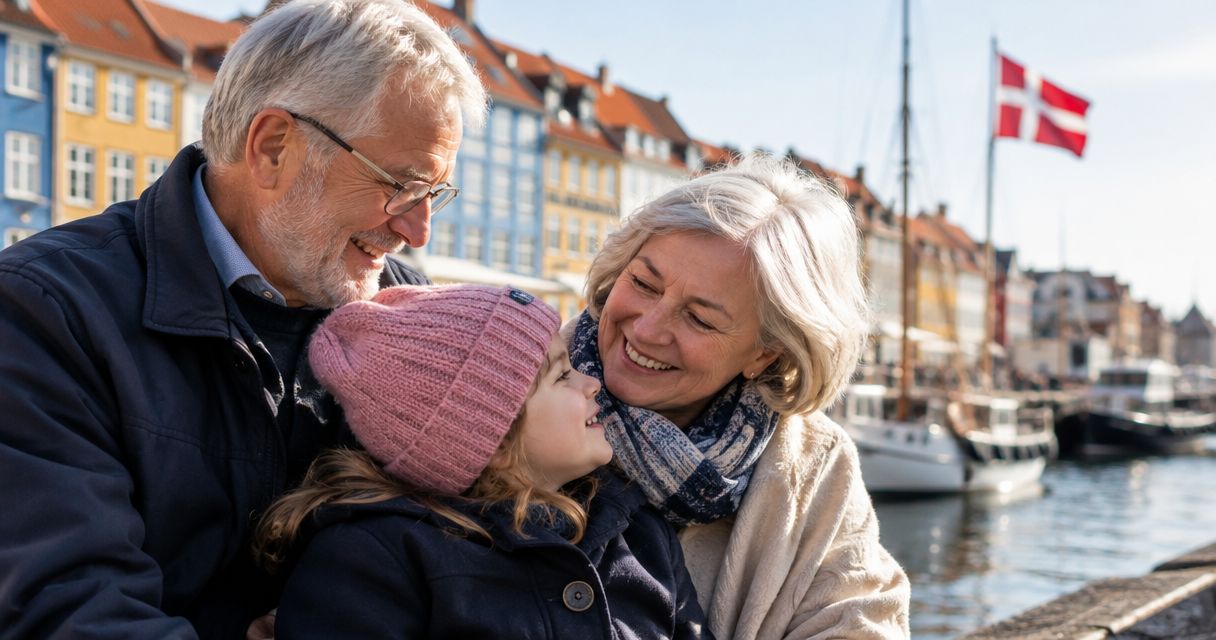
General information about the rules in force. Not legal advice. Last updated 10 October 2026.
Grandparents are not a standard category for family reunification in Denmark. A residence permit for a grandparent is only possible in narrow situations, usually through an assessment of exceptional reasons, through EU rules, or through a different permit route.
- Grandparents family reunification in Denmark has no standard category under the Danish Aliens Act.
- Permits for grandparents depend on exceptional reasons, EU free movement rules or a separate permit route.
- Udlændingestyrelsen decides first; appeals in permit cases go to Udlændingenævnet.
- A short visit visa is a different thing and does not lead to a residence permit.
Why this matters
Many families in Denmark want an older relative close by, often to help with children or to receive care. Readers often assume that family reunification works for any close relative. It does not. The Danish rules name specific family members, and grandparents are not among the standard ones.
This page explains in general terms how the rules work. It is not advice on an individual case. Globe Advokater is a Copenhagen law firm that works with these questions in Danish and English.
Can grandparents apply for family reunification in Denmark?
Not as a standard right. Danish family reunification, called familiesammenføring, is built around the core family: spouses and partners, and children. Grandparents sit outside that core. This means there is usually no ordinary application form or permit type that fits a grandparent.
There are still a few routes that the rules open in specific circumstances. The table gives the general picture.
| Route | What it is | Who decides | Main limit |
|---|---|---|---|
| Standard family reunification | Permit for spouse, partner or child | Udlændingestyrelsen | Grandparents are not a listed group |
| Exceptional reasons | Case-by-case assessment of særlige grunde, including Denmark's international obligations | Udlændingestyrelsen | Applies only in narrow situations |
| EU free movement rules | Residence rights for certain dependent relatives of EU citizens | SIRI | Only where the EU citizen uses EU rights and the relative is dependent |
| Another permit type | For example a work, study or retirement-related route | Depends on the route | The grandparent must meet that route's own conditions |
| Visit visa | Short stay, not residence | Danish visa authorities | Does not lead to a residence permit |
Exceptional reasons: the narrow route
The Aliens Act, udlændingeloven, allows a residence permit when there are særlige grunde - exceptional reasons. This includes cases where Denmark's international obligations apply, for example the right to respect for family life.
This is not a right to a permit. The authority looks at the full picture of the family. The relationship between a grandparent and a grandchild alone is generally not enough. Questions that matter in such an assessment include how close the family tie is in practice and whether there is real dependence between the persons involved.
Because this route turns on the facts, the outcome cannot be predicted from general rules. Deadlines apply in this type of case. Contact a lawyer to find out which deadlines apply in your case.
EU rules: dependent relatives
When the family member in Denmark is an EU citizen who lives here under EU free movement rules, the starting point is different. EU rules cover certain relatives in the ascending line - parents and grandparents - where they are dependent on the EU citizen. SIRI handles EU residence documents.
The rules look at actual dependence, not just a family tie. This route does not apply to Danish citizens living in Denmark in the same way.
Other permit routes for an older relative
Some grandparents qualify for a permit for reasons unrelated to family ties. A grandparent who has a job offer, a business role or an independent income may fall under a different scheme. These routes have their own conditions, and family connection plays no part in them.
For related options, see the guide on residence permit options for retirees in Denmark. The family tie is often stronger for parents than for grandparents, and the guide to residence permits for parents of Danish children covers that side.
Why the outcome varies
The result depends on facts that differ from one family to the next. The main factors:
- the legal status of the family member in Denmark, for example Danish citizen, EU citizen or non-EU resident
- whether the grandparent is dependent on the family member, and in what way
- whether other close family members are available to the grandparent in the home country
- the grandparent's health and care needs, where documented
- whether another permit route fits the grandparent's own situation
- the documentation available to show the facts
Which authority decides and who handles appeals?
Udlændingestyrelsen decides permit applications in the first instance. A refusal in a permit case can be appealed to Udlændingenævnet. EU residence documents are handled by SIRI. Asylum cases follow a separate system with Flygtningenævnet as the appeal body, and this is not the route for family reunification.
Can a grandparent visit Denmark instead?
Yes, a visit is a different matter. A visit visa allows a short stay. It does not give a right to live in Denmark, and it does not turn into a residence permit. Whether a visa is needed depends on the grandparent's nationality.
Can a grandparent come to Denmark to look after grandchildren?
Caring for grandchildren is not a standard ground for a residence permit. In general, the rules do not treat childcare help by a grandparent as a reason on its own for a permit.
Do the rules differ for spouses and partners?
Yes. Spouses and partners fall in a defined category with its own conditions. For a comparison of reunification routes, see family reunification visas ranked by approval difficulty.
FAQ
Can grandparents get a residence permit through family reunification in Denmark?
Not through a standard category. Grandparents are not a listed group in Danish family reunification. A permit is only possible through exceptional reasons, EU rules or another permit route.
Which authority decides on a permit for a grandparent?
Udlændingestyrelsen decides in the first instance. SIRI handles EU residence documents. Appeals in permit cases go to Udlændingenævnet.
Can a grandparent move to Denmark to help with childcare?
Help with childcare is not a standard ground for a residence permit. The rules treat each application on its own facts.
Does a visit visa lead to a residence permit?
No. A visit visa allows a short stay only and does not give a right to settle in Denmark.
Do EU rules help grandparents of an EU citizen?
They can, where the grandparent is dependent on the EU citizen and the EU citizen uses free movement rights. The assessment looks at actual dependence.
Is a refusal for a grandparent final?
A refusal in a permit case can be appealed to Udlændingenævnet. A lawyer can explain the appeal process in your case.
One last thing
The question most families ask is whether a grandparent counts as family. The better question is which legal route fits the facts. The same grandparent can fall under different rules depending on whether the relative in Denmark is a Danish citizen, an EU citizen or a non-EU resident. Mapping that first saves time and avoids an application under the wrong category.
To discuss a specific situation, book a meeting with the firm through the contact page.
Related guides
This article is general information about the rules and practice in force. It is not legal advice, it does not assess your specific case, and reading it does not create a client relationship.
Rules, deadlines and the practice of the authorities change. We accept no liability for errors or for changes after the update date. Always check the information with the relevant authority or contact a lawyer before you act.
If you have a specific case, you are welcome to contact Globe Advokater for an assessment.
Last updated 10 October 2026.