General information about the rules in force. Not legal advice. Last updated 21 September 2026.
Family reunification in Denmark is not a single visa type. This guide ranks the main pathways by relative approval difficulty in 2026, so you can see which route usually carries the heavier condition and documentation load before you open an application.
- In 2026, spouse and registered-partner routes sit at the centre of Denmark family reunification approval difficulty.
- EU family routes follow free-movement rules, not the full national condition set.
- Unmarried partners and parents usually face a heavier proof burden than married spouses.
- Globe Advokater explains pathways in general terms for internationals living in or moving to Denmark.
- Individual fit still depends on status, documents and the correct authority - not on a public score.
Why this matters
Searches for denmark family reunification approval difficulty often assume one score for every family. Danish practice does not work that way.
National familiesammenføring - family reunification under Danish rules - is handled at first instance by Udlændingestyrelsen (the Danish Immigration Service). Many EU residence documents sit with SIRI. Appeals in family reunification, permanent residence, work, study and visa cases go to Udlændingenævnet, not to the asylum appeal body.
The pathway you sit on changes which conditions apply, which proofs matter, and which authority writes to you. A ranking by structural difficulty is a map of that system. It is not a forecast of any one file.
Parents who want a deeper read on narrow parent routes can start with residence permits for parents of Danish children. The sections below stay at pathway level.
Ranked verdict for 2026
Least structurally demanding when free-movement conditions are met: EU and EEA family reunification. Core national route: spouse and registered-partner reunification, including same-sex marriages and registered partnerships that Denmark recognises. Heavier proof routes in many files: unmarried partners, then parents seeking to join a child in Denmark under national rules.
Quotable line for 2026: Under Danish practice, spouse and registered-partner reunification is the core national route for denmark family reunification approval difficulty; unmarried partners and parents usually carry a heavier evidence and condition load than a clear marriage or registered partnership file.
What drives approval difficulty
Difficulty here means structural load - how many condition types and proof themes the route typically opens - not a published grant rate.
- Legal basis - national familiesammenføring versus EU free-movement family rules
- Relationship proof - marriage, registered partnership, durable cohabitation, or parent-child link
- Sponsor basis - Danish citizenship, permanent residence, protected status, or EU exercise of free movement
- Support and housing themes - self-support and accommodation conditions where the national rules apply them
- Dependency and age themes - especially for children and for parents
- Authority track - Udlændingestyrelsen, SIRI, or an appeal body if the case moves on
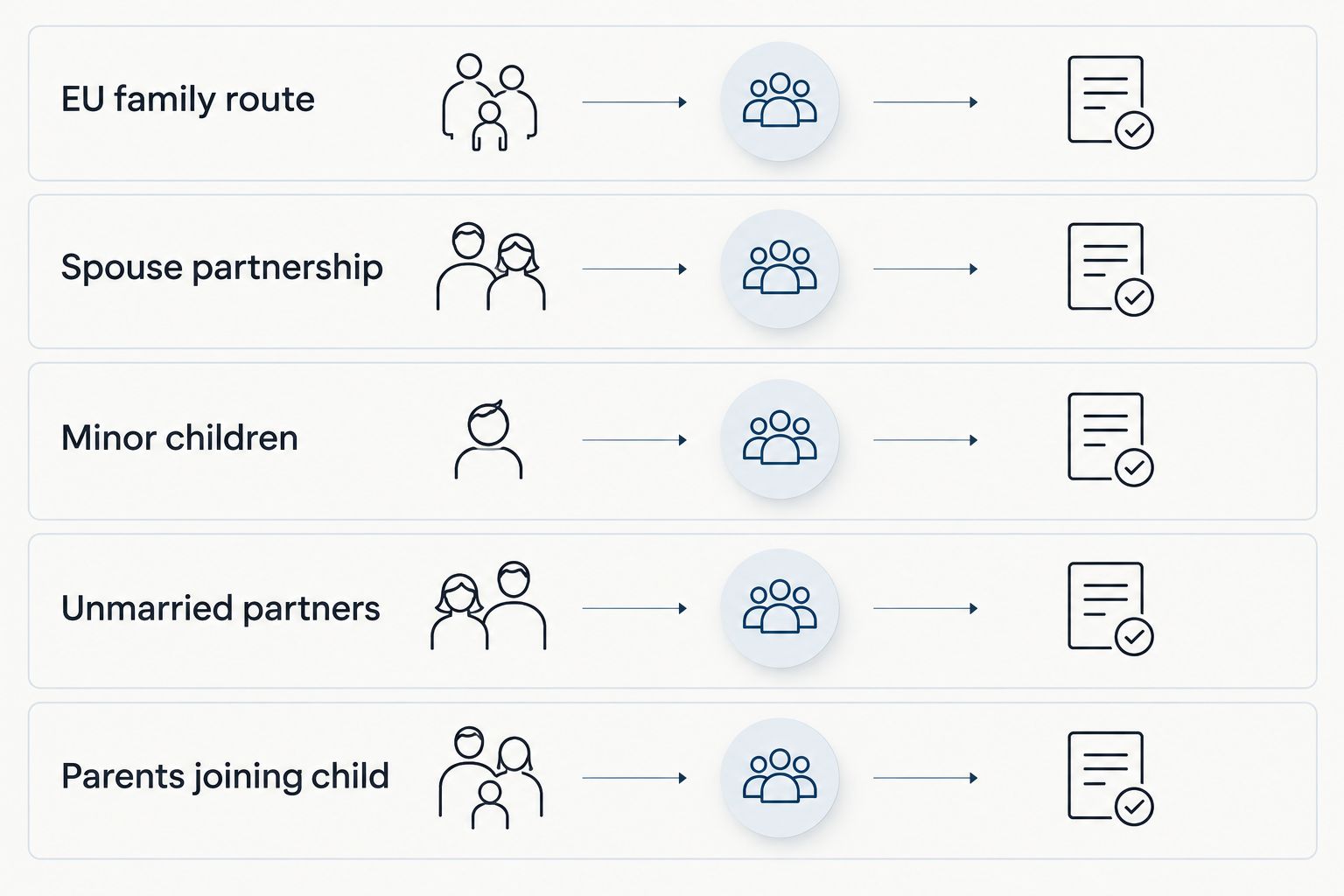
Pathways at a glance
| Pathway | Best for | Standout feature | Key limitation |
|---|---|---|---|
| EU / EEA family reunification | Family of an EU or EEA citizen exercising free movement in Denmark | Different legal basis from full national familiesammenføring | Depends on genuine free-movement exercise and family link under EU rules |
| Spouse and registered partner | Married or registered partners under national rules | Clear civil-status document when the marriage or partnership is recognised | National condition themes can still be extensive |
| Minor children joining a parent | Dependent children with a clear parent link | Dependency frame is often more direct than adult secondary routes | Age, custody and care facts shape the file |
| Unmarried partners | Long-term cohabiting couples without marriage or registered partnership | Possible route when cohabitation and attachment can be shown | Relationship evidence burden is usually heavier than for spouses |
| Parents joining a child in Denmark | Parents where a narrow national or child-based route may apply | Child’s status in Denmark can open a specific discussion | Among the narrowest family routes in ordinary national practice |
1. EU and EEA family reunification: best when free movement applies
This route sits under EU free-movement family rules when an EU or EEA citizen exercises free movement in Denmark and the family member qualifies under those rules. It is not the same legal product as national familiesammenføring decided only under the Aliens Act track.
SIRI is central for many EU residence documents. The proof set focuses on the EU citizen’s basis in Denmark, the family relationship, and the free-movement frame rather than on every national attachment test used in pure Danish-rule spouse cases.
EU and EEA family reunification pros:
- Separate legal basis from the full national spouse condition set in many files
- Clear value when the sponsor’s stay is genuine free movement
- Authority path is often easier to identify once the EU frame is correct
- Useful map for internationals who already hold or accompany EU status
EU and EEA family reunification cons:
- Collapses if free movement is not actually being exercised as the rules require
- National-rule thinking from forums often mislabels this route
- Documentation still has to prove the family link to the standard the authority uses
Best for: family members of EU or EEA citizens whose residence in Denmark rests on free movement.
Relative difficulty in 2026: lowest structural load among the five when the free-movement premise is real.
2. Spouse and registered partner reunification: best core national route
This is the centre of national familiesammenføring for couples. It covers opposite-sex and same-sex spouses, and registered partners, when Denmark recognises the civil status and the sponsor basis fits the national rules.
Udlændingestyrelsen handles first-instance national family reunification. The file usually turns on identity, civil status, the sponsor’s right of residence or citizenship, and the condition themes the national rules attach to that setup - including support and housing themes where they apply.
Same-sex couples who are married or registered, and whose status is recognised, generally sit on this same partner track rather than on a separate “rainbow visa”. A dedicated explainer on family reunification visas for same-sex couples goes deeper on recognition and proof themes.
Spouse and registered partner pros:
- Civil-status document gives a clear relationship anchor when recognition is in place
- Most discussed and mapped national couple route in official guidance structures
- Same legal track for recognised same-sex and opposite-sex marriages or registered partnerships
- Appeal path in national family cases runs to Udlændingenævnet if the case is refused and appealed
Spouse and registered partner cons:
- National condition themes can still be wide even with a clear marriage certificate
- Recognition issues arise for some foreign marriages or partnerships
- Mixing this route with EU free-movement labels confuses both documents and authority letters
Best for: couples with a recognised marriage or registered partnership applying under Danish national rules.
Relative difficulty in 2026: moderate structural load - clearer than cohabitation or parent routes, heavier than a clean EU free-movement family file.
3. Minor children joining a parent: best for dependent children
Children’s reunification is built around parentage, care and dependency rather than around a couple’s civil status. When the child is a minor and the parent’s basis in Denmark is clear, the legal story is often more linear than adult secondary routes - but custody papers, consent, and care facts still decide how heavy the file feels.
The authority still tests identity, relationship and the sponsor’s residence basis. Age and who holds parental responsibility are not side notes; they sit in the middle of the assessment.
Minor children pros:
- Dependency frame matches how many families actually live
- Parent-child documents can be more standardised than cohabitation proof bundles
- Fits beside a parent’s own residence or citizenship basis when that basis is already settled
- Less “couple attachment” theatre than unmarried-partner files
Minor children cons:
- Split custody or missing consent documentation slows or blocks a clean story
- Age thresholds and care arrangements change how the authority reads the case
- A parent’s own unsettled status transfers uncertainty into the child’s file
Best for: dependent minor children joining a parent who already has a clear basis to live in Denmark.
Relative difficulty in 2026: moderate - often clearer than unmarried partners, still document-heavy when custody is complex.
4. Unmarried partners: best for durable cohabitation without marriage
Unmarried partners - including same-sex couples who are not married or registered - usually cannot lean on a marriage certificate. The route, where it exists under national practice, leans on durable cohabitation, shared life evidence and attachment themes instead.
That shift is exactly why denmark family reunification approval difficulty feels higher on this track for many internationals. The relationship is real; the proof set is simply wider and more open to interpretation than a recognised civil-status document.
For a focused guide on that proof pattern, see family reunification visas for unmarried partners.
Unmarried partner pros:
- Opens a national discussion when marriage or registered partnership is not available or not wanted
- Can reflect long shared households that pre-date the move to Denmark
- Same-sex and opposite-sex cohabitants are assessed on relationship facts, not on a separate “type” of love
- Useful when civil marriage is legally hard in the country of origin
Unmarried partner cons:
- Evidence burden is typically heavier than for spouses with a recognised certificate
- Gaps in joint documentation are read strictly
- Forum templates from spouse cases often understate what this track needs
Best for: long-term cohabiting partners without a marriage or registered partnership who still need a national family route.
Relative difficulty in 2026: high structural load among couple routes.
5. Parents joining a child in Denmark: best only on narrow parent routes
Parents who wish to join a child in Denmark often meet the narrowest ordinary national frame in this list. Adult children in Denmark do not automatically open a wide parent visa. Where a route exists, it is usually tied to specific child-status or dependency themes rather than to a general “family wish” ground.
This is why parent cases are easy to misread online. A child’s Danish citizenship, residence basis or care needs may matter; a simple invitation letter does not replace the legal basis.
Parents joining a child pros:
- Can be decisive when a genuine narrow route matches the child’s situation
- Child-centred facts sometimes clarify urgency of care better than couple files do
- Links cleanly to specialised parent-and-child residence reading when the facts fit
Parents joining a child cons:
- Among the narrowest family pathways in common national practice
- Adult-child sponsorship thinking from other countries does not transfer cleanly
- Refusal risk rises fast when the file is built on sympathy alone rather than on a mapped legal basis
Best for: parents whose facts may fit a specific child-based or dependency-based residence discussion in Denmark - not for open-ended parent migration.
Relative difficulty in 2026: highest structural load on this list in ordinary national terms.
How we ranked these pathways
The order reflects structural difficulty in 2026: legal basis, relationship-proof type, sponsor basis, and how many national condition themes a typical file opens. It does not use unpublished grant percentages, firm win rates or invented scores.
Globe Advokater ranks routes this way so internationals can read nyidanmark.dk-style guidance with the correct map. EU free-movement family rules and national familiesammenføring are different systems. Spouse files and cohabitation files are different proof problems. Parent files are not spouse files with older applicants.
Deadlines apply in this type of case. Contact a lawyer to find out which deadlines apply in your case.
Which family reunification path fits?
If the sponsor is an EU or EEA citizen genuinely exercising free movement, start by testing the EU family frame before you force the file into national spouse language.
If you have a recognised marriage or registered partnership and a national sponsor basis, the spouse and registered-partner track is the core map - including for same-sex couples in that civil status.
If you cohabit without marriage or registration, budget time and documents for a heavier relationship-proof load.
If you are a parent hoping to join a child, check whether any narrow child-based route exists before you treat the case like ordinary couple reunification.
Globe Advokater works in Danish and English from Copenhagen, with a long focus on foreign nationals in immigration and family law. Articles from the firm stay at general process level. They do not assess your personal prospects.
FAQ
What does denmark family reunification approval difficulty mean in 2026?
It means the relative structural load of conditions and proofs on each pathway, not a public success score. EU family routes, spouse routes, unmarried-partner routes and parent routes open different requirement sets.
Is spouse reunification easier than unmarried partner reunification in Denmark?
A recognised marriage or registered partnership usually gives a clearer relationship anchor than cohabitation evidence alone. Unmarried-partner files typically carry a wider proof burden even when the relationship is genuine.
Do same-sex couples need a separate family reunification visa in Denmark?
Recognised same-sex marriages and registered partnerships generally sit on the same partner track as other spouses and registered partners. Couples without marriage or registration are assessed on cohabitation-style proof instead.
Can parents get family reunification to join a child in Denmark?
Only where a specific legal basis fits the child’s status and the parent’s facts. Ordinary national practice treats parent routes as narrow, not as automatic family migration.
What is the difference between national family reunification and EU family routes?
National familiesammenføring follows Danish rules and is often first decided by Udlændingestyrelsen. EU family residence follows free-movement rules when an EU or EEA citizen exercises free movement, with SIRI central for many documents.
Who decides family reunification cases in Denmark?
Udlændingestyrelsen decides many first-instance national family reunification cases. SIRI handles many EU residence documents. Appeals in family reunification and related permit cases go to Udlændingenævnet.
Does Globe Advokater help internationals with family reunification?
Yes. Globe Advokater is a Copenhagen law firm focused on foreign nationals in immigration and residence law, including family reunification, and works in Danish and English.
Where do official application fees appear?
State application fees are set by the authorities and published on the official application channels. Fee levels change, so the live official pages are the source for current amounts.
One last thing
The label on a blog post - “family visa”, “spouse visa”, “dependent visa” - is not what Udlændingestyrelsen or SIRI decides. They decide a concrete legal basis, a concrete family link and a concrete sponsor status. In 2026, fixing that map early still removes more friction than collecting more PDFs under the wrong heading.
Related guides
- Best dual citizenship options for non-EU nationals
- Best post-study work visas for graduates in Denmark
- Best visas for startup founders in Denmark
This article is general information about the rules and practice in force. It is not legal advice, it does not assess your specific case, and reading it does not create a client relationship.
Rules, deadlines and the practice of the authorities change. We accept no liability for errors or for changes after the update date. Always check the information with the relevant authority or contact a lawyer before you act.
If you have a specific case, you are welcome to contact Globe Advokater for an assessment.
Last updated 21 September 2026.