General information about the rules in force. Not legal advice. Last updated 29 September 2026.
This guide explains the residence routes open to retirees who want to live in Denmark in 2026, who each route fits and where each one stops. The short answer on a residence permit for retirees in Denmark: Danish law has no dedicated pension or retirement permit, so the route depends on your citizenship and your family ties.
- Denmark has no pension or retirement residence permit for non-EU retirees in 2026.
- EU, EEA and Swiss retirees with own means use the EU residence rules, handled by SIRI.
- Nordic citizens can live in Denmark without a residence permit, jf. udlændingelovens § 1.
- Non-EU retirees with a spouse or partner in Denmark can apply for familiesammenføring under § 9.
- Other non-EU retirees depend on exceptional reasons under udlændingelovens § 9 c.
The routes in order of reach: the EU residence document covers the widest group of retirees. Nordic citizenship is the simplest route, because no permit is needed. For non-EU retirees with a spouse or partner living in Denmark, the route is familiesammenføring - family reunification. For all other non-EU retirees, the only route is an application based on exceptional reasons under udlændingelovens § 9 c.
Why this matters
Many retirees search for a Danish retirement visa because other countries offer one. Denmark does not. This means a plan built on a retirement visa has no legal basis in Denmark in 2026.
The routes that do exist are narrow and depend on who you are, not on how much money you have. A retiree from Germany and a retiree from the United States with the same pension face completely different rules. The same is true for a retired parent whose adult children live in Denmark - that situation is covered in more detail in our guide to residence permits for parents of Danish children.
Knowing which route applies to you before you sell a home or move belongings saves time and avoids a refusal based on the wrong legal basis.
What makes a residence route workable for retirees
The routes in this guide are ordered using five criteria. They let you check the ranking before you see it.
- Who can use it - the citizenship or family tie the route requires.
- Legal basis - the provision in Danish or EU law the route rests on.
- Authority - the body that decides the case, which is the name on your letters.
- Conditions - what the applicant or the person in Denmark has to document.
- Reach - how many retirees the route is realistically open to.
Residence routes for retirees at a glance
| Route | Fits | Legal basis | Authority | Key limitation |
|---|---|---|---|---|
| EU residence document | EU, EEA and Swiss retirees with own means | Directive 2004/38/EC, Article 7 | SIRI | Requires sufficient resources and sickness insurance cover |
| Nordic citizenship | Finnish, Icelandic, Norwegian and Swedish retirees | Udlændingelovens § 1 | No permit needed | Only for Nordic citizens |
| Familiesammenføring with a spouse or partner | Non-EU retirees with a partner living in Denmark | Udlændingelovens § 9 | Udlændingestyrelsen | Many conditions for both partners |
| Exceptional reasons | Other non-EU retirees, including parents of adult children | Udlændingelovens § 9 c | Udlændingestyrelsen | Granted only in exceptional cases |
The diagram below shows how the routes follow from two questions: your citizenship and your family ties in Denmark.
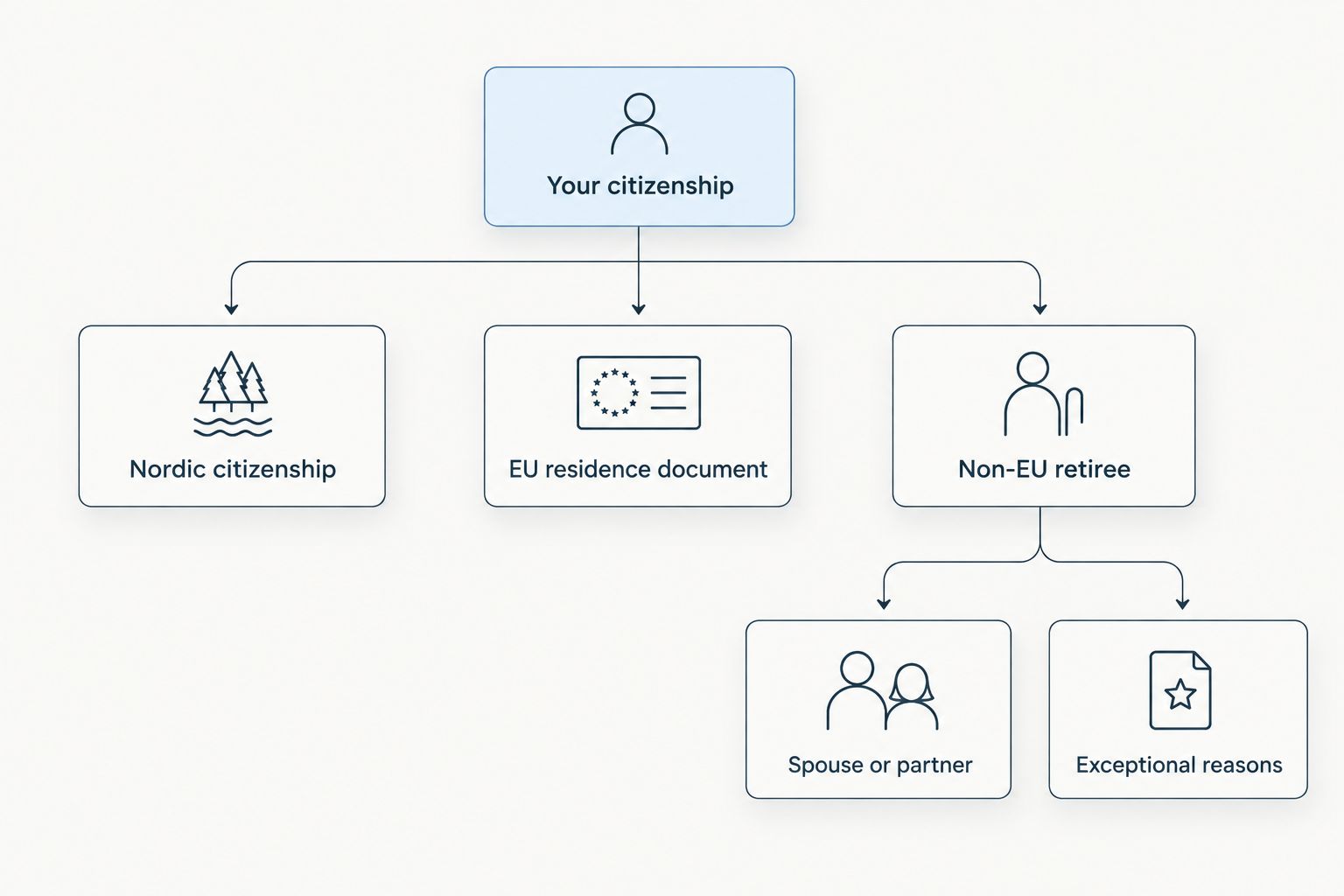
Each route is described below. The descriptions explain how the rules work in general. They do not assess any individual case.
1. EU residence document: the route for EU, EEA and Swiss retirees
EU, EEA and Swiss citizens have a right of residence under EU free movement rules. For people who do not work, Directive 2004/38/EC, Article 7(1)(b), gives a right to reside when the person has sufficient resources and comprehensive sickness insurance cover. In Denmark, SIRI - Styrelsen for International Rekruttering og Integration, the Danish Agency for International Recruitment and Integration - issues the EU residence document.
A retired EU citizen does not apply for a retirement permit. The application is for documentation of an existing right under EU law.
EU residence document - advantages:
- It rests on EU law, not on a discretionary Danish decision.
- It does not depend on family ties in Denmark.
- The same rules apply to EEA and Swiss citizens.
- Close family members can be covered by the same EU rules.
EU residence document - limitations:
- The applicant has to document sufficient resources and sickness insurance cover.
- It is not open to citizens of countries outside the EU, EEA and Switzerland.
EU residence document - cost: fees and documentation requirements are set out on siri.dk.
Fits: EU, EEA and Swiss retirees who live on their own pension or savings.
2. Nordic citizenship: the route for Nordic retirees
Citizens of Finland, Iceland, Norway and Sweden can enter and live in Denmark without a residence permit, jf. udlændingelovens § 1. For a retired Nordic citizen, this is the simplest route in 2026, because there is no permit application at all.
Moving to Denmark still involves practical steps, such as registration with the local municipality. These are administrative steps, not a residence permit.
Nordic citizenship - advantages:
- No residence permit is required.
- No conditions on pension, savings or family ties apply for the right to live in Denmark.
- No decision from an immigration authority is needed.
Nordic citizenship - limitations:
- It covers only citizens of the four Nordic countries named in § 1.
- A spouse from outside the Nordic countries has to use a separate legal basis.
Fits: Finnish, Icelandic, Norwegian and Swedish retirees.
3. Spousal family reunification: the route for retirees with a partner in Denmark
A non-EU retiree who is married to, or lives in a lasting relationship with, a person living in Denmark can apply for familiesammenføring - family reunification - jf. udlændingelovens § 9, stk. 1, nr. 1. The person in Denmark is called the reference person. Udlændingestyrelsen - the Danish Immigration Service - decides the case at first instance.
The rules place conditions on both partners, including conditions on the reference person's housing and finances. The full list of conditions is published on nyidanmark.dk. Cohabiting partners who are not married are covered by the same provision, and our guide to family reunification for unmarried partners explains how the relationship is documented.
Family reunification with a spouse or partner - advantages:
- It is open to non-EU citizens, unlike the EU and Nordic routes.
- Age is not a barrier for retirees, because the age requirement concerns younger applicants and has exceptions under § 9 c.
- A granted permit gives a lawful basis to live in Denmark with the partner.
Family reunification with a spouse or partner - limitations:
- It depends entirely on the relationship with a reference person in Denmark.
- Both partners have to meet a number of documented conditions.
- A refusal has to be appealed to Udlændingenævnet - the Immigration Appeals Board.
Family reunification with a spouse or partner - cost: the application fee is published on nyidanmark.dk.
Fits: non-EU retirees who are married to, or live with, a person resident in Denmark.
4. Exceptional reasons under § 9 c: the route for other non-EU retirees
For non-EU retirees without a spouse or partner in Denmark, the remaining legal basis is udlændingelovens § 9 c, stk. 1. It allows a residence permit when exceptional reasons speak for it. Danish rules have no general scheme for parents who want to join adult children in Denmark, so a retired parent is usually assessed under this provision.
Udlændingestyrelsen decides these cases. The assessment is individual, and the provision is used only in exceptional situations.
Exceptional reasons - advantages:
- It is the only route open to non-EU retirees who do not fit the other three routes.
- The authority looks at the full circumstances of the case.
Exceptional reasons - limitations:
- It is not a scheme with fixed conditions that an applicant can simply meet.
- A strong wish to live near family in Denmark is not in itself an exceptional reason.
- The outcome depends on an individual assessment, so the result cannot be predicted from general rules.
Fits: non-EU retirees, including parents of adult children in Denmark, whose situation may involve exceptional reasons.
What does not give residence to retirees
Some options look like residence routes but are not.
- A Schengen visa covers short stays only. It is not a residence permit.
- Owning property in Denmark does not in itself give a right to live in Denmark.
- A pension paid into a Danish account does not create a right of residence.
These points matter because readers often plan a move around one of them.
How the routes are ordered
The order follows the reach criterion from the list above. The EU residence document comes first because it is open to the largest group of retirees and rests on EU law. Nordic citizenship follows because it needs no permit, but it covers fewer countries.
Family reunification with a partner comes third, because it is open to non-EU citizens but depends on a relationship with a reference person. Exceptional reasons under § 9 c comes last, because it is granted only in exceptional cases. The order describes how wide each route is. It is not a recommendation for any individual.
Which route fits which retiree?
For most retirees, citizenship answers the question. An EU, EEA or Swiss retiree with own means looks at the EU residence document. A Nordic retiree needs no permit.
A non-EU retiree with a spouse or partner in Denmark looks at familiesammenføring under § 9. A non-EU retiree without a partner in Denmark depends on § 9 c. The question of which route applies to a specific person, and what documentation that person needs, is an individual question. Globe Advokater handles these questions in a consultation. Contact us through the contact page on our website to book a meeting.
FAQ
Does Denmark have a retirement visa?
No. Danish law has no dedicated pension or retirement residence permit. Retirees use the EU rules, the Nordic rules, family reunification or exceptional reasons, depending on citizenship and family ties.
Can a non-EU retiree move to Denmark?
Only through a specific legal basis. The main routes are family reunification with a spouse or partner under udlændingelovens § 9 and exceptional reasons under § 9 c.
Can a retired parent join adult children living in Denmark?
Danish rules have no general scheme for parents of adult children. A retired parent is usually assessed under exceptional reasons, jf. udlændingelovens § 9 c.
Do Nordic pensioners need a residence permit in Denmark?
No. Citizens of Finland, Iceland, Norway and Sweden can live in Denmark without a residence permit, jf. udlændingelovens § 1. Administrative steps such as municipal registration still apply.
Which authority handles an EU residence document for a retiree?
SIRI handles EU residence documents. The right itself comes from EU free movement rules in Directive 2004/38/EC.
Who decides family reunification for a retired spouse?
Udlændingestyrelsen decides family reunification cases at first instance. Appeals go to Udlændingenævnet.
Does buying a home in Denmark give a retiree the right to live there?
No. Owning property in Denmark does not in itself give a right of residence. A separate legal basis is needed.
One last thing
A refused family reunification or § 9 c application is appealed to Udlændingenævnet, not to Flygtningenævnet. Flygtningenævnet handles asylum appeals only. Sending an appeal to the wrong body is a common source of confusion for families. Deadlines apply in this type of case. Contact a lawyer to find out which deadlines apply in your case.
Family reunification cases differ a great deal in how demanding the documentation is. Our overview of family reunification routes ranked by approval difficulty explains the differences in general terms. Globe Advokater works with residence cases in Danish and English.
Related guides
- Inheritance planning options for foreigners in Denmark
- Dual citizenship options for non-EU nationals
This article is general information about the rules and practice in force. It is not legal advice, it does not assess your specific case, and reading it does not create a client relationship.
Rules, deadlines and the practice of the authorities change. We accept no liability for errors or for changes after the update date. Always check the information with the relevant authority or contact a lawyer before you act.
If you have a specific case, you are welcome to contact Globe Advokater for an assessment.
Last updated 29 September 2026.