
General information about the rules in force. Not legal advice. Last updated 6 October 2026.
A residence permit in Denmark for a company director depends on the role the person actually holds, not on the title in the company register. This guide explains how the main routes work for foreign directors and executives, and where each route stops.
- A residence permit in Denmark for a company director depends on the real role: employee, owner or founder.
- Employed executives usually apply under the work schemes in udlændingeloven § 9 a, handled by SIRI.
- Founders who run their own start-up have a separate route, covered in our start-up founder guide.
- A registered directorship in Denmark does not by itself give a right to live here.
- Refusals are appealed to Udlændingenævnet, not Flygtningenævnet.
What a residence permit for a company director means in 2026
Foreign company director residence in Denmark is the set of rules that decide whether a non-Danish manager, board member or owner may live and work in Denmark while running a company. The aim is to match the person to the correct permit category, so the application fits the facts.
Denmark does not have one permit called director visa. A director can be a salaried employee, a shareholder who owns the business, or a founder building a new company. Each position leads to a different route. The authority looks at what the person will do day to day, who pays them and who controls the company.
For a first look at the start-up route, see our guide to visas for startup founders in Denmark.
Why this matters for directors and executives
Executives often assume that a board seat or a managing director role in a Danish company is enough. It is not. A registration in the Danish company register shows who is responsible for the company. It does not by itself give a right of residence.
The rules also differ by nationality. Citizens of EU and EEA countries use EU free movement rules and do not apply for a work-based permit in the same way. Citizens of other countries, often called third-country nationals, need a permit before they start work. The rest of this guide is about third-country nationals.
There is a practical reason to understand the categories early. A permit is tied to a purpose. If the role changes, for example from employee to owner, the basis for the stay may change too. The reader will often meet this question in a letter from the authority, so it helps to know the vocabulary before then.
Who decides what
The authorities have separate tasks. Mixing them up is a common source of confusion.
- SIRI - the Danish Agency for International Recruitment and Integration - handles work and study schemes, including Beløbsordningen, Fast-track and Positivlisten.
- Udlændingestyrelsen - the Danish Immigration Service - decides other first-instance residence cases, such as family reunification.
- Udlændingenævnet - the Immigration Appeals Board - hears appeals in residence permit and work permit cases.
- Flygtningenævnet - the Refugee Appeals Board - hears only asylum appeals. It is not the appeal body for work permits.
You can read about the formal basis for work-based residence in udlændingeloven § 9 a on retsinformation.dk, the official legal database. The practice-area page on work permits gives the general overview. This article goes one level deeper into the director role.
How to work out the right route
The steps below show the order in which the question is usually examined. The manual route comes first. A lawyer can then take over the parts that need legal judgement.
Identify your real role in the company
Start with what the person will do and who they will do it for. The title is secondary.
- Is the person paid a salary by a Danish company or by a foreign group company?
- Does the person own shares, and if so what share of the company?
- Does the person control hiring, budgets and strategy, or follow instructions from a parent company?
- Is the Danish company already trading, or is it new?
- Will the person manage staff in Denmark?
- Is the person a board member only, without daily work?
These answers decide which category the authority considers.
Check whether you need a permit at all
Not every foreign director needs a Danish work-based permit. Some situations fall outside the normal work schemes.
- EU and EEA citizens rely on EU rules and register their stay in a different way.
- Family members of an EU citizen may have rights derived from that citizen.
- A person who already holds a residence permit with work rights may not need a new work permit for a new role.
- A board member who does no work in Denmark may fall outside the work rules, depending on the facts.
The question of whether work is carried out in Denmark is a legal one. It is worth settling before any application is filed.
Match the role to a scheme
Three schemes are most often used for employed executives. All three sit under the work permit rules in udlændingeloven § 9 a and are handled by SIRI.
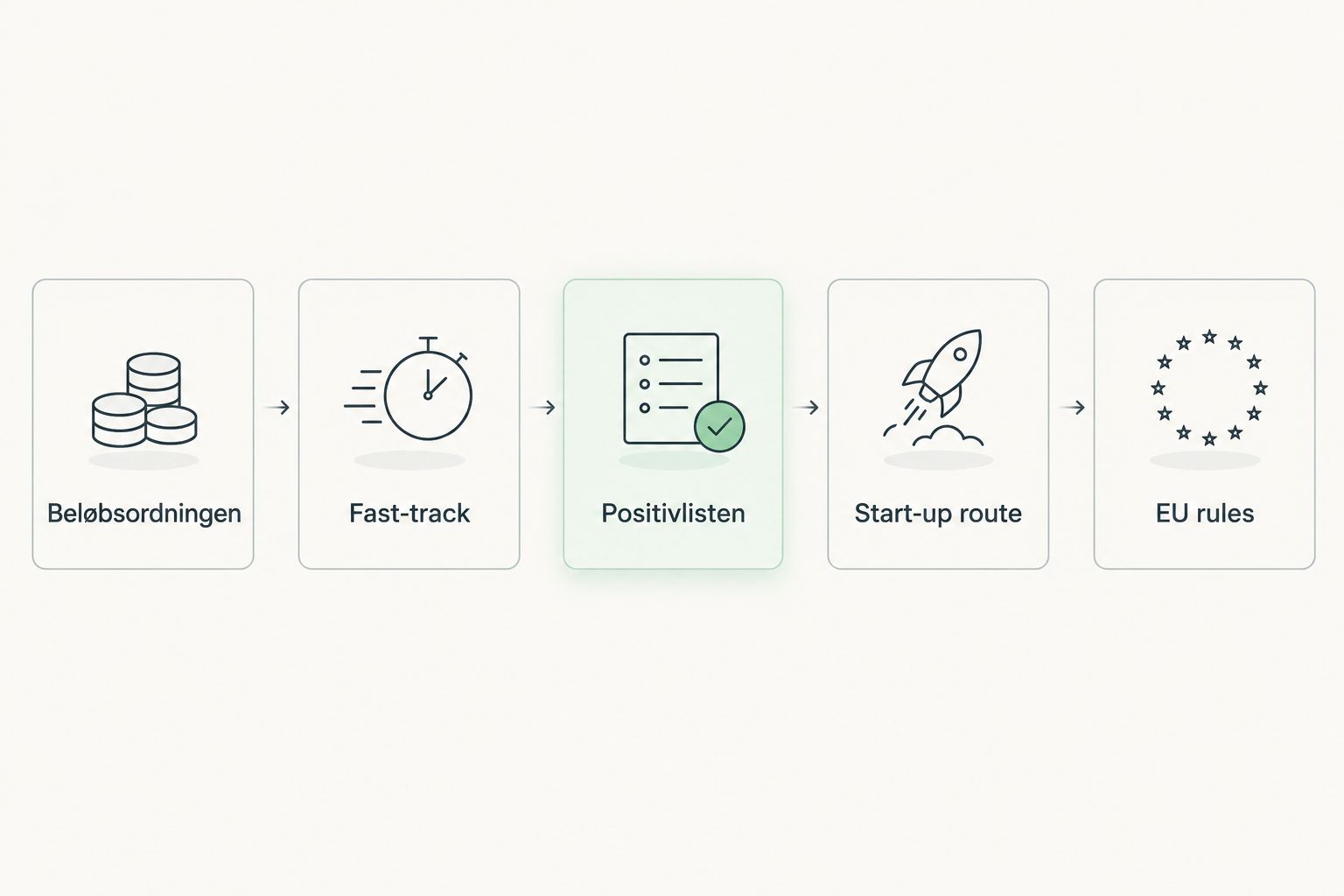
- Beløbsordningen - the pay limit scheme - is based on a job offer with a salary above a set threshold. The threshold changes each year, so the current figure is taken from SIRI at the time of application.
- Fast-track - the certified company scheme - lets a company that SIRI has certified recruit foreign staff on a faster basis. It depends on the company, not on the person.
- Positivlisten - the list of professions with a shortage of qualified workers - applies only if the role is on the list. Many executive roles are not.
Our article on Positivlisten professions explains how the list works and why a management title rarely fits it.
Consider the owner and founder route
A person who owns and runs a business is not an employee in the usual sense. The authority looks at whether the business is real, whether it can support the person and whether it creates value in Denmark. A start-up founder has a dedicated scheme, described in our start-up founder guide. The authority examines the business plan and the person's background.
This route is document heavy. The authority considers the plan, the company structure and the funding, and an unclear structure is a frequent cause of questions.
Prepare the company side
The Danish company plays a part in the application, whichever route is used.
- A registered company with a Danish company number.
- A clear employment contract or a clear description of the owner role.
- Evidence of how the position is paid.
- A description of the duties and why they are carried out in Denmark.
- Proof that the company is a genuine business, such as accounts or agreements with customers.
Weak or inconsistent company documents slow a case more often than the personal documents do.
Plan for the family
A residence permit for the director does not automatically cover the spouse and children. Family members normally apply on their own basis, often linked to the director's permit. The rules for this are explained in our guide on family reunification.
It helps to treat the family application as part of the same plan, because the family's right to stay usually depends on the director's permit staying valid.
Comparison of the main routes
| Route | Best for | Key limitation |
|---|---|---|
| Beløbsordningen | Employed executives with a high-salary job offer | Salary must reach the annual threshold set by the authority |
| Fast-track | Executives joining a company certified by SIRI | Depends on the employer holding the certification |
| Positivlisten | Specialists in professions on the list | Most management roles are not on the list |
| Start-up route | Founders building a new, innovative company | Requires a business plan the authority accepts |
| EU and EEA rules | Citizens of EU and EEA countries | Does not apply to third-country nationals |
The table gives the general picture. The exact conditions come from the official text and from SIRI at the time of application.
Documents that usually come up
The list depends on the route, but several documents appear again and again.
- A valid passport.
- The employment contract, or the company agreement for an owner.
- Company registration documents from the Danish company register.
- Proof of qualifications and work history.
- Evidence of the salary or the income of the business.
- Authorisations or powers of attorney if a representative files the case.
Documents in a language other than Danish or English often need a translation. The authority states what it accepts on nyidanmark.dk, the official portal for applications.
What happens after a refusal
A refusal is a decision with reasons. The reasons show which condition the authority did not consider met. A decision in a work permit or residence permit case is appealed to Udlændingenævnet, not to Flygtningenævnet.
Deadlines apply in this type of case. Contact a lawyer to find out which deadlines apply in your case.
A refusal does not close every door. Sometimes a different scheme fits the facts better, or the application needs better documents. Whether that is the case depends on the individual file, and it is a question for a consultation.
Common mistakes company directors make
- Treating the title as the basis. A director title in the register does not decide the permit category. The actual role does.
- Starting work before the permit is in place. Work without a valid permit can affect later applications.
- Choosing the scheme by speed alone. A faster scheme is no use if the role or the employer does not meet its conditions. Our article on work permits ranked by processing time explains why timing is not the only factor.
- Using incomplete company documents. The authority needs to see that the business is real and that the role exists.
- Forgetting the family. Spouses and children have their own applications, and these are easier to plan from the start.
- Assuming the permit never changes. A change of role, employer or ownership can change the basis for the stay.
How the 2026 rules are checked
The rules in force in 2026 are set out in udlændingeloven and in the related executive orders on retsinformation.dk. Salary thresholds and company certification terms are published by SIRI and change over time. The figures in force at the time of filing are the ones that count, so they are read from the official source on the day.
If you move into the IT sector as a manager, the rules for technical specialists may also be relevant. See our guide to work permits for IT professionals.
Globe Advokater is a Copenhagen law firm with more than 20 years of practice, working in Danish and English. We explain how the rules work in general. We do not assess an individual case in an article. To discuss your own situation, book a meeting or contact us through the firm's contact page.
FAQ
Can a foreign director live in Denmark on a company registration alone?
No. A registration in the Danish company register shows who is responsible for the company. It does not give a right of residence. A third-country national needs a permit based on the actual role.
Which authority handles work permits for executives?
SIRI handles the work and study schemes, including Beløbsordningen, Fast-track and Positivlisten. Other residence cases, such as family reunification, go to Udlændingestyrelsen.
Is there a separate director visa in Denmark?
No single permit has that name. The route depends on whether the person is an employee, an owner or a founder. Each role fits a different scheme.
Do EU citizens need a work permit to be a director in Denmark?
EU and EEA citizens rely on EU free movement rules and do not apply for the same work-based permits. The rules differ for third-country nationals.
Does the director's permit cover the spouse and children?
Not automatically. Family members normally apply on their own basis, often linked to the director's permit. The family rules are described in our family reunification guide.
Where is a refusal appealed?
A refusal in a work permit or residence permit case is appealed to Udlændingenævnet. Flygtningenævnet hears asylum appeals only.
Is a start-up founder treated as a director?
A founder who builds a new company usually falls under the start-up route, not the employee schemes. The authority examines the business plan and the person's background.
One last thing
The most useful question to answer first is not which scheme is fastest. It is who will pay the person and who controls the company. That one answer often decides the whole route, and it is easier to settle before the company documents are written than after.
Related guides
- Family reunification visas explained
- Positivlisten professions and fast-track permits
- Work permits ranked by processing time
- Work permits for IT professionals
This article is general information about the rules and practice in force. It is not legal advice, it does not assess your specific case, and reading it does not create a client relationship.
Rules, deadlines and the practice of the authorities change. We accept no liability for errors or for changes after the update date. Always check the information with the relevant authority or contact a lawyer before you act.
If you have a specific case, you are welcome to contact Globe Advokater for an assessment.
Last updated 6 October 2026.