
General information about the rules in force. Not legal advice. Last updated 21 September 2026.
In 2026, Denmark work permit processing time depends on which scheme the application uses and on whether the employer is certified for Fast-track. Fast-track is the track built for certified companies. Beløbsordningen - the Pay Limit scheme - and Positivlisten - the Positive List - run on SIRI’s ordinary work-permit track.
- Fast-track is the 2026 track built for certified employers at SIRI.
- Beløbsordningen and Positivlisten use SIRI’s ordinary work-permit track.
- Denmark work permit processing time rises when the file is incomplete.
- The right scheme depends on the job, the salary gate and list match.
- Deadlines apply in this type of case. Contact a lawyer about your case.
Why this matters
Employers and foreign hires often compare Danish work schemes only by salary or job title. Scheme design is a separate factor. In 2026, a file filed under the wrong track still faces refusal risk even when the CV looks strong.
Globe Advokater works with employees and employers on Danish work and residence matters. This page ranks the main work schemes by how they are structured for handling speed. It does not rank outcomes and it does not promise a result. For role-specific routes, see best work permits for IT professionals in Denmark.
Deadlines apply in this type of case. Contact a lawyer to find out which deadlines apply in your case.
What shapes Denmark work permit processing time
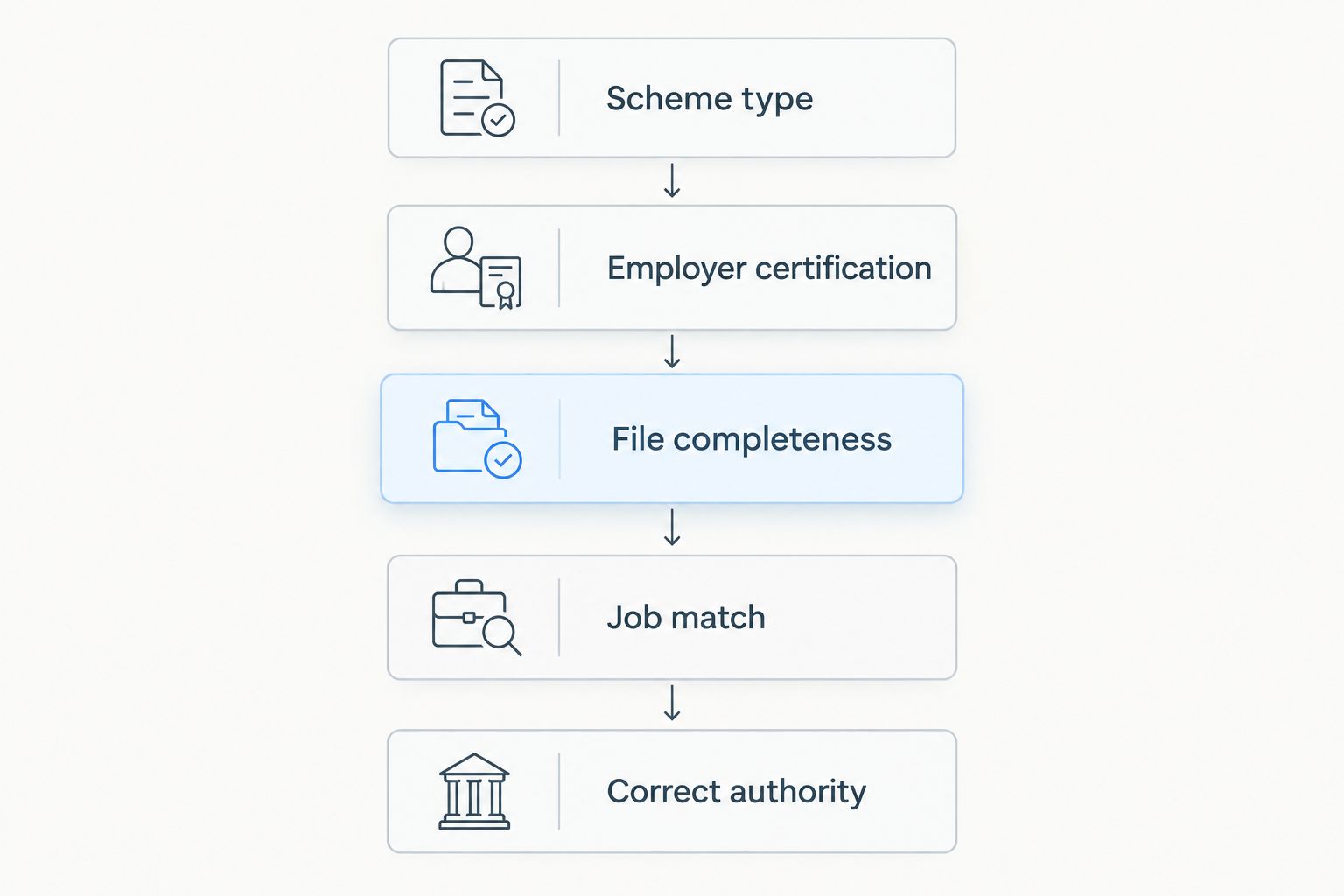
These factors decide how a work file moves at SIRI in 2026:
- Scheme type - Fast-track has a separate path for certified companies
- Employer certification - only certified employers can use Fast-track for the employee
- File completeness - contracts, diplomas, authorisations and translations must match the scheme rules
- Job match - the role must fit the salary gate, the list or the research setup
- Correct authority - SIRI handles the main work and study schemes named below
A complete Fast-track file and an incomplete ordinary-track file are not the same kind of application. The scheme label on the form matters before any caseworker review begins.
Work schemes at a glance
| Scheme | Suited for | Standout feature | Key limitation |
|---|---|---|---|
| Fast-track | Hires by certified employers | Separate certified track at SIRI | Employer must hold certification |
| Beløbsordningen | Roles that meet the pay gate | Salary-based entry without a shortage list | Annual salary threshold must be met |
| Positivlisten | Shortage occupations on the lists | List match can open the ordinary track | Job title and duties must match the list |
| EU Blue Card | Highly qualified non-EU hires | EU-aligned highly qualified route | Education and salary rules still apply |
| Researcher scheme | Research posts with approved hosts | Built around research employment | Host and project must fit the scheme |
1. Fast-track scheme: suited for certified employers
The Fast-track scheme - Fast-track-ordningen - is a SIRI work scheme for foreign employees hired by certified Danish companies. The employer holds the certification. The employee rides that track when the job and the scheme conditions fit.
Certification is about the company, not about a personal ranking of the candidate. If the employer is not certified, Fast-track is not available for that hire and another scheme must carry the file.
Fast-track pros:
- Separate track designed for certified employers
- Covers several employment situations under one certified-company framework
- Aligns the company and the hire on a single SIRI path
- Widely used for skilled international recruitment in 2026
Fast-track cons:
- Closed if the employer has no certification
- Still requires a real job that fits the scheme rules
- Incomplete contracts or missing annexes still stop the file
Suited for: international hires where the Danish employer is already certified and the role fits Fast-track conditions.
2. Beløbsordningen: suited for salary-gate roles
Beløbsordningen - the Pay Limit scheme - is a SIRI work scheme where a qualifying salary level is the main gate. The job does not need to sit on a shortage list. The salary and the employment terms must meet the scheme rules in force for the year of application.
In 2026 the annual threshold is set by the authorities and can change by year. This article does not restate the figure. The current official threshold belongs on nyidanmark.dk at the time of filing.
Beløbsordningen pros:
- No need for a Positivlisten job title match
- Clear salary-based logic employers can test before filing
- Common path for specialists whose role is real but not list-based
- Ordinary SIRI work-permit track with well-known document patterns
Beløbsordningen cons:
- Roles under the threshold cannot use this gate
- Salary alone does not cure a weak employment contract
- Not the certified Fast-track path unless the employer also uses Fast-track where allowed
Suited for: full-time roles that meet the pay gate and do not depend on a shortage-list title.
3. Positivlisten: suited for shortage-list occupations
Positivlisten - the Positive List - names occupations with a shortage of qualified labour in Denmark. When the job matches the list in force, the hire can use the related work-permit path under SIRI rules. List versions differ for highly educated roles and for skilled work, and the published lists change over time.
A loose job title is not enough. Duties, education and the list wording must line up. For list-led planning, see Positivlisten professions for Fast-track work permits.
Positivlisten pros:
- Opens a path when the occupation is on the current list
- Useful where pay is solid but below a pure pay-gate strategy
- Transparent public lists employers can check before offer stage
- Can combine with other recruitment planning in shortage sectors
Positivlisten cons:
- No match on the live list means this path is closed
- List updates can move a title on or off between offer and filing
- Document proof of qualifications still carries the file
Suited for: roles that clearly match a live Positive List entry and the education or trade proof the list expects.
4. EU Blue Card: suited for highly qualified non-EU profiles
The EU Blue Card is a highly qualified employment route implemented in Danish rules and handled in the Danish system through SIRI for the relevant applications. It targets non-EU nationals with high qualification levels and employment terms that meet the Blue Card conditions.
It is not a free substitute for Fast-track or Beløbsordningen. Education evidence, the job and the salary conditions must fit the Blue Card framework as applied in Denmark in 2026.
EU Blue Card pros:
- Built for highly qualified employment across an EU-aligned design
- Useful when the profile is degree-led and the contract meets the gate
- Recognised route name employers already know from other EU states
EU Blue Card cons:
- Qualification and contract evidence is heavier than a simple list match
- Not available merely because a role is skilled in ordinary language
- Wrong scheme choice still wastes a full filing cycle
Suited for: highly qualified non-EU hires whose education and contract meet Blue Card conditions under Danish application practice.
5. Researcher scheme: suited for approved research hosts
The researcher scheme is aimed at foreign researchers employed in research roles with hosts that fit the scheme. The employment and the research setting are central. It is not a general private-sector shortage route and it is not a pay-gate shortcut for ordinary commercial jobs.
SIRI remains the authority frame for the work schemes described on this page. The host institution and the research employment terms decide whether this scheme is even open.
Researcher scheme pros:
- Designed around research employment rather than a commercial shortage list
- Clear fit when the host and project are genuine research setups
- Avoids forcing a research hire into an ill-fitting pay or list scheme
Researcher scheme cons:
- Ordinary commercial roles do not belong here
- Host and project documentation is specific and non-negotiable
- Mis-filing a commercial job as research weakens the whole application
Suited for: research employees with an approved host and a real research employment basis.
How we ranked these schemes
The order follows scheme design for handling structure in 2026, not a measured league table of calendar days and not a prediction for any one file.
- Fast-track sits first because certification creates a separate employer track
- Beløbsordningen sits second as a standard-track gate driven by pay level
- Positivlisten sits third as a standard-track gate driven by shortage lists
- EU Blue Card sits fourth as a highly qualified route with its own condition set
- Researcher sits fifth because it is host- and project-specific rather than a general hire path
File quality still decides whether any track moves. A certified track with missing annexes is not a complete application. Globe Advokater reviews scheme fit and document structure before filing; this page stays at general scheme design only.
Which work permit track fits
If the employer is certified and the role fits Fast-track conditions, Fast-track is the track built for that setup in 2026. If the role meets the pay gate and list match is irrelevant, Beløbsordningen is the usual salary-gate path. If the occupation sits on the live Positive List, Positivlisten is the list-gate path. Highly qualified profiles may sit on the EU Blue Card conditions instead. Research hosts use the researcher scheme when the post is a genuine research employment.
Scheme fit is a facts test: employer status, job content, salary terms, education proof and the live official lists. It is not a preference test. Healthcare hires and trade hires often need a tighter title match than generic specialist roles - see work permits for healthcare workers in Denmark when the occupation is clinical or authorised.
Globe Advokater can map the job offer to the scheme rules in a meeting. Reading this page does not open a client file and does not replace a review of the actual contract and annexes.
FAQ
What affects Denmark work permit processing time in 2026?
Scheme type, employer certification, document completeness and job match shape how SIRI handles a work file in 2026. Fast-track is the track built for certified employers; other schemes use the ordinary work-permit track.
Is Fast-track always the right work scheme?
No. Fast-track is only open when the employer is certified and the role fits Fast-track conditions. Other hires use Beløbsordningen, Positivlisten, the EU Blue Card or the researcher scheme instead.
What is Beløbsordningen?
Beløbsordningen is the Pay Limit scheme. It is a SIRI work path where a qualifying salary level is the main gate rather than a shortage-list title.
What is Positivlisten?
Positivlisten is the Positive List of shortage occupations. When the job matches the live list and the scheme rules, the hire can use the related SIRI work path.
Who handles Danish work permit applications?
SIRI handles the main Danish work and study schemes described on this page, including Fast-track, Beløbsordningen and Positivlisten routes.
Does a high salary replace the need for the right scheme?
No. Salary may open Beløbsordningen when the threshold is met, but the job, contract and scheme rules must still fit. The wrong scheme label still produces a weak file.
Can a startup hire on the same tracks as a large company?
Yes when scheme conditions are met. Certification, salary gates and list match apply to the job and the employer status, not to company size alone. Related founder routes are separate from ordinary employee work schemes.
Is this page legal advice on my work permit?
No. It explains scheme design in general terms for 2026. Individual files need a review of the contract, the employer status and the live official rules.
One last thing
Fast-track certification belongs to the employer. Employees sometimes assume a strong CV creates Fast-track access on its own. In 2026 the company certification status still decides whether that track exists at all before SIRI reads the CV.
Related guides
- Best visa sponsorship schemes for startups hiring abroad
- Best post-study work visas for graduates in Denmark
- Best work permits for skilled trades workers in Denmark
This article is general information about the rules and practice in force. It is not legal advice, it does not assess your specific case, and reading it does not create a client relationship.
Rules, deadlines and the practice of the authorities change. We accept no liability for errors or for changes after the update date. Always check the information with the relevant authority or contact a lawyer before you act.
If you have a specific case, you are welcome to contact Globe Advokater for an assessment.
Last updated 21 September 2026.