
General information about the rules in force. Not legal advice. Last updated 17 October 2026.
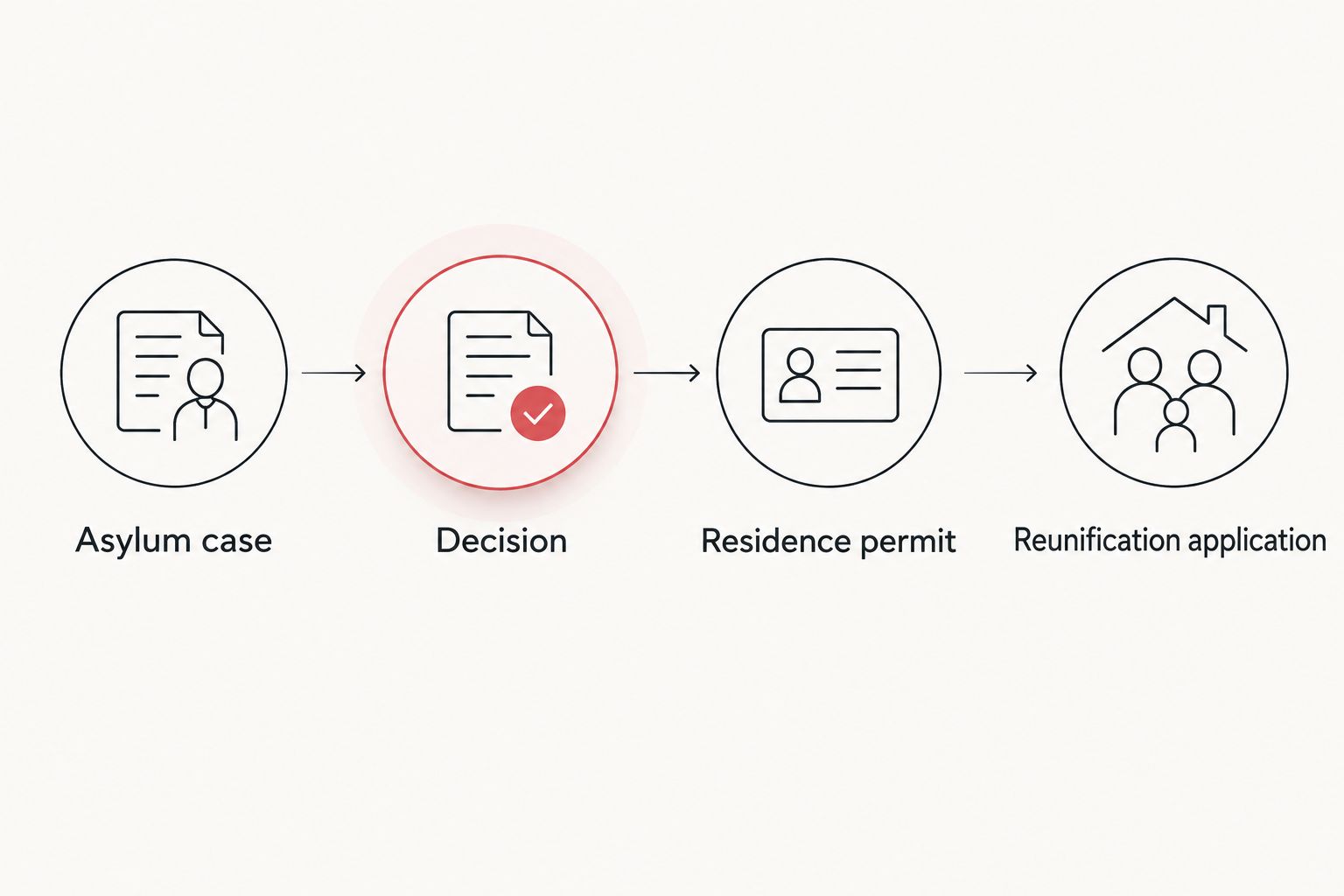
Family reunification and asylum are two separate procedures in Denmark. While an asylum case is pending, the rules mean a family reunification application cannot normally be built on that case, because the person who is waiting has not yet been granted a residence permit.
- Family reunification while an asylum case is pending is generally not available, because the reference person has no residence permit yet.
- Asylum cases are decided by Udlændingestyrelsen, with appeals to Flygtningenævnet. Family reunification appeals go to Udlændingenævnet.
- Once a permit is granted, family reunification becomes a separate application under udlændingelovens § 9 or related provisions.
- The type of permit granted decides which family reunification rules apply.
Can you apply for family reunification while asylum is pending?
In general, no. Family reunification - familiesammenføring - means that a person living in Denmark applies for a family member to join them. The person living in Denmark is called the reference person. Under the Aliens Act, jf. udlændingelovens § 9, the reference person must have a legal basis for living in Denmark, such as Danish citizenship or a residence permit of a qualifying type.
An asylum seeker with a pending case has applied for protection, but has not been granted a residence permit. That means there is usually no qualifying reference person yet. The family reunification route opens only after the asylum case ends with a permit.
The practical result is simple. The two procedures run one after the other, not at the same time.
Why a pending asylum case is not a basis for reunification
An asylum application asks Denmark to decide whether you need protection. A family reunification application asks Denmark to let a family member join someone who already has a right to live here. These are different questions, decided under different provisions.
The authorities involved also differ in the later stages. This matters because letters from the wrong authority are often the first sign that a case is on the wrong track.
| Question | First decision | Appeal |
|---|---|---|
| Asylum | Udlændingestyrelsen | Flygtningenævnet |
| Family reunification | Udlændingestyrelsen | Udlændingenævnet |
Asylum appeals never go to Udlændingenævnet. Family reunification appeals never go to Flygtningenævnet. Mixing them up is a common and costly mistake.
What changes after a residence permit is granted
When an asylum case ends with a permit, the person becomes a possible reference person. The permit type then shapes what is possible. Udlændingeloven § 7 covers several forms of protection, and the rules for bringing family members depend on which form was granted.
The main points the authorities look at are these:
- the type of residence permit held by the reference person
- the relationship between the reference person and the family member
- the family member's age and civil status
- whether the reference person meets the general conditions in the Aliens Act
- whether any exceptions in the Aliens Act apply to the case
The conditions for a spouse are not the same as for a child or a parent. For an overview of how different family routes compare, see our guide on family reunification visas ranked by approval difficulty.
Family members who are already in Denmark
Some families arrive together. In that situation the family members can be part of the asylum process itself, and each person's situation is assessed in the asylum case. That is not family reunification. It is a separate way for relatives to be covered by the same procedure.
If a relative arrives later, the question moves back to the reunification rules described above. Whether a relative can be assessed together with the asylum case or must apply separately depends on the facts, which a lawyer can check against the file.
Why the answer varies between cases
The general answer is the same for most families, but the details differ. These factors change the outcome:
- the form of protection granted in the asylum case
- how the family member is related to the reference person
- whether the family member is a child or an adult
- whether the marriage or partnership is recognised under Danish rules
- where the family member is living when the application is made
- whether the case involves exceptional circumstances covered by the Aliens Act
Unmarried couples face their own conditions. Our guide on family reunification for unmarried partners explains how those cases are handled.
Can a spouse apply while the asylum decision is still open?
Generally no. The reference person needs a qualifying legal basis in Denmark first. A pending asylum application is a request for that basis, not the basis itself.
Can children join a parent who is still waiting for an asylum decision?
Children are assessed under their own provisions, and the rules for children differ from those for spouses. A pending asylum case does not by itself give the parent a right to bring a child. Once the parent has a permit, the child's route is examined against the type of permit granted.
Does a refusal of asylum end any chance of reunification?
A refusal means the asylum route has not produced a permit. A family reunification application needs a reference person with a legal basis to live in Denmark, so the position of the person who was refused is central. Deadlines apply in this type of case. Contact a lawyer to find out which deadlines apply in your case.
What the authorities will want to see
Family reunification files are document heavy. The authorities generally look for proof of identity, proof of the family relationship and proof that the Aliens Act conditions are met. Documents from abroad often need to be legalised or translated, and gaps are a frequent cause of delay.
The official application route is run through nyidanmark.dk, where the current forms and requirements are published. Those pages are the source for what the authorities currently ask for.
When a lawyer can help
Most people reach this question while worried about a separated family. A lawyer can explain which procedure applies, which authority will decide, and how the type of permit affects the options. In asylum cases before Flygtningenævnet, the lawyer's fee is covered regardless of the outcome, and the applicant may choose their own lawyer instead of accepting the appointed one.
Globe Advokater works in Danish and English with immigration and residence law. To discuss a specific situation, book a meeting through our contact page.
FAQ
Can I apply for family reunification while my asylum case is pending?
In general, no. Family reunification requires a reference person with a legal basis to live in Denmark, and a pending asylum case has not yet produced a residence permit.
Which authority decides family reunification?
Udlændingestyrelsen decides in the first instance. Appeals in family reunification cases go to Udlændingenævnet.
Where are asylum appeals sent?
Asylum appeals go to Flygtningenævnet. They do not go to Udlændingenævnet, which handles family reunification and similar permit appeals.
Does the type of asylum permit matter for family reunification?
Yes. Udlændingeloven § 7 covers different forms of protection, and the family reunification rules depend on which form the reference person holds.
Can my family be part of my asylum case instead?
Family members who are in Denmark can in some situations be assessed in connection with the asylum case. That is a different procedure from family reunification.
Is the lawyer paid for in an asylum case before Flygtningenævnet?
Yes. In cases before Flygtningenævnet, the lawyer's fee is covered regardless of outcome, and the applicant may choose their own lawyer.
Can a lawyer tell me if I qualify?
A lawyer can review the facts of an individual case and explain how the rules apply. General articles like this one cannot do that.
One last thing
The most common source of confusion is the idea that all family-related applications are one process. They are not. Asylum, family reunification and later steps such as permanent residence each have their own conditions and their own appeal body. Knowing which process a letter belongs to is the first step to answering it correctly.
Related guides
- Residence permits for parents of Danish children
- Family reunification options for adopted children
- Globe Advokater
This article is general information about the rules and practice in force. It is not legal advice, it does not assess your specific case, and reading it does not create a client relationship.
Rules, deadlines and the practice of the authorities change. We accept no liability for errors or for changes after the update date. Always check the information with the relevant authority or contact a lawyer before you act.
If you have a specific case, you are welcome to contact Globe Advokater for an assessment.
Last updated 17 October 2026.