General information about the rules in force. Not legal advice. Last updated 6 October 2026.
Permanent residence to Danish citizenship is a separate process with its own authority, its own conditions and its own decision-maker. This guide walks through the workflow as it stands in 2026, so you know what happens at each stage before you start.
- Permanent residence and Danish citizenship are two different applications handled by two different bodies.
- Citizenship is granted by an act of the Danish Parliament, Folketinget, after review by Udlændinge- og Integrationsministeriet.
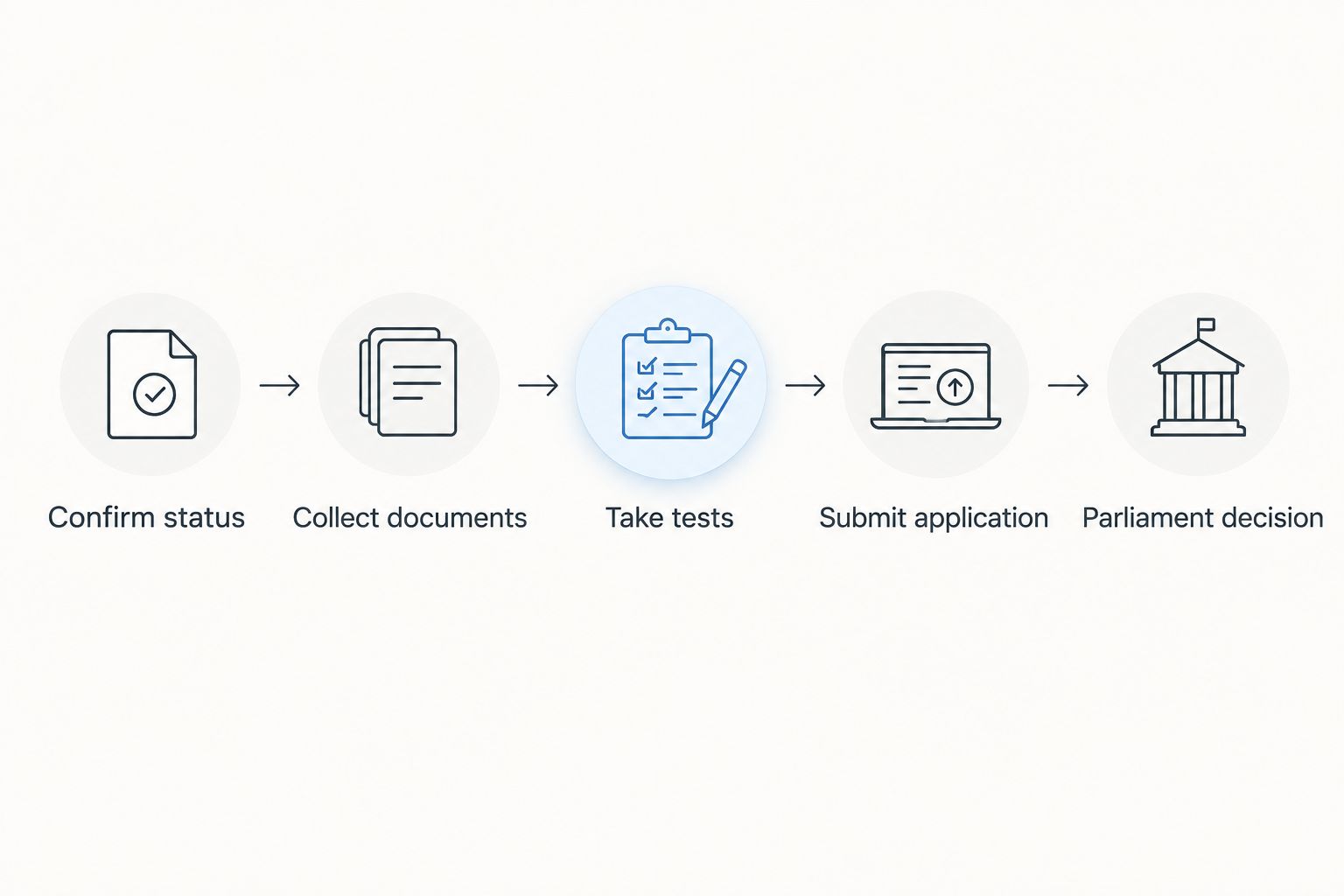
- The usual steps are: check conditions, collect documents, take the required tests, apply, then wait for the decision.
- Danish law allows dual citizenship, but your other country decides whether you can keep its citizenship.
Why this matters
Many internationals assume that a permanent residence permit leads to citizenship automatically. It does not. A permanent residence permit - tidsubegrænset opholdstilladelse - gives you the right to stay in Denmark. Citizenship - indfødsret - gives you the Danish passport and the right to vote in national elections.
The two cases are decided by different authorities. Udlændingestyrelsen handles permanent residence in the first instance. Udlændinge- og Integrationsministeriet handles citizenship and naturalisation. Mixing them up is the most common source of confusion, so keep the split in mind from the start.
If you need an overview of the application route itself, the firm's practice area page on Danish citizenship is the place to begin. This article goes one level deeper and follows the workflow in order.
Before you start
- You need your current residence documents, valid identification and a record of where you have lived. The authority checks your residence history.
- You need access to a digital signature, since public applications in Denmark are generally submitted online.
- Be aware of the gotcha that stops many applications mid-way: the conditions are not only about how long you have lived in Denmark. Self-support, criminal record, debt to public authorities and language and knowledge tests are all checked. A gap in one of them can stop the case even when everything else is in order.
The rules are set out in the Danish citizenship legislation, indfødsretsloven, and in the guidelines the ministry applies under it. Always check the current text on retsinformation.dk and nyidanmark.dk, because the conditions are adjusted from time to time.
Step group 1: Confirm your starting point
This stage decides whether it makes sense to apply at all.
- Check which residence status you hold. A permanent residence permit, an EU residence document and a temporary permit are treated differently in the citizenship assessment.
- Go through the conditions on the official page for citizenship. Note every condition that depends on a document you do not yet have.
- Separate what you can fix from what you cannot. A missing language test can be taken. A criminal record cannot be changed.
Expected result: you have a short list of conditions you meet and conditions you still need to meet.
Step group 2: Collect your documents
- Gather identity documents, including your passport.
- Gather proof of your residence history in Denmark and abroad, so the authority can see where you have lived.
- Gather documents on your income and employment or other self-support, as the ministry checks that you support yourself.
- Check for debt to public authorities. Outstanding public debt is a condition the ministry reviews.
Expected result: one folder, digital or paper, where each condition has its supporting document.
Step group 3: Take the required tests
Citizenship applicants are in general required to show Danish language skills and knowledge of Danish society, history and culture. In practice this means a Danish language test and the citizenship test, Indfødsretsprøven.
- Find the approved test provider through the official sites.
- Register for the test and keep the proof of registration.
- Keep the certificate once you pass. You will attach it to the application.
Expected result: you hold the test certificates the application asks for.
Deadlines apply in this type of case. Contact a lawyer to find out which deadlines apply in your case.
Step group 4: Submit the application
- Open the official application form for citizenship through the Danish authorities' online service.
- Fill in each section from your document folder. Answer exactly what the form asks.
- Upload the supporting documents in the places the form shows.
- Sign digitally and submit.
Expected result: you receive a confirmation that the application has been received. Keep it.
If you hold citizenship in another country, this is also the point where dual citizenship becomes relevant. Danish law allows it, but your other country may not. Our guide to dual citizenship options for non-EU nationals explains the Danish side of that question.
Step group 5: The decision
Citizenship is not granted by an official in an ordinary decision. The ministry reviews the case, and successful applicants are included in a naturalisation act, lov om indfødsrets meddelelse, which Folketinget passes. You become a Danish citizen when the act takes effect, and you are told in writing.
The authority considers the full file. It does not only count years of residence. Because the Parliament passes the act, the process follows its own calendar and the authority does not set the pace alone.
Expected result: either a notice that you are included in a naturalisation act, or a refusal with reasons.
A second workflow: your case is refused or stops
A refusal or a stopped case follows a different path. Read the reasons given in the letter first. They tell you which condition the ministry found unmet.
- If the reason is a missing document or test, you may be able to meet that condition and apply again.
- If the reason is a condition you cannot change quickly, such as a criminal record, the rules set how long the condition counts against you.
- If the reason concerns a decision on your residence permit, the appeal body depends on the type of decision. Do not assume it is the same body as for citizenship.
Deadlines apply in this type of case. Contact a lawyer to find out which deadlines apply in your case.
Troubleshooting
- Problem: your application asks for a document you do not have. Ask the issuing body for it early, because foreign authorities can be slow.
- Problem: you are unsure whether you are treated as having permanent residence. Check your residence card and the wording of the decision, since an EU document is not the same as a permanent permit.
- Problem: public debt appears in the file. Look into the debt before you apply, because it is a condition the ministry reviews.
- Problem: a test certificate does not match the name in your passport. Correct the spelling with the provider before you upload it.
- Problem: you applied under one status and your status changes before the decision. Tell the authority, because the assessment is made on your situation.
Customize your workflow
Your route to citizenship often starts earlier than the permanent residence permit. If you came through family ties, read about residence permits for parents of Danish children. If you are planning ahead for a spouse or child, the guide to family reunification routes explains how the options differ.
The rules mean that every case is read on its own facts. If you want a lawyer to look at your documents, you can contact us at Globe Advokater in Bredgade 30, Copenhagen. We work in Danish and English.
FAQ
Does permanent residence lead to Danish citizenship automatically?
No. Permanent residence and citizenship are separate applications. Udlændingestyrelsen handles permanent residence, and Udlændinge- og Integrationsministeriet handles citizenship.
Who decides on Danish citizenship?
Folketinget grants citizenship through a naturalisation act. The ministry prepares the case before that.
Do I need to pass a Danish language test?
In general, yes. The citizenship conditions include Danish language skills, and there is also a citizenship test, Indfødsretsprøven, on Danish society, history and culture.
Can I keep my other citizenship?
Danish law allows dual citizenship. Whether you keep your other citizenship depends on the rules of that country.
Is a criminal record checked?
Yes. The ministry reviews criminal convictions as one of the conditions for citizenship.
Does public debt affect my application?
Yes. Outstanding debt to public authorities is one of the conditions the ministry reviews.
Are permanent residence and an EU residence document the same?
No. They are different statuses with different legal bases, and the citizenship assessment treats them differently.
One last thing
The most useful habit is to build the document folder before you open the application form. Cases usually stall on a missing paper, not on the form itself.
Related guides
- Best residence permit options for retirees in Denmark
- Best inheritance planning options for foreigners in Denmark
This article is general information about the rules and practice in force. It is not legal advice, it does not assess your specific case, and reading it does not create a client relationship.
Rules, deadlines and the practice of the authorities change. We accept no liability for errors or for changes after the update date. Always check the information with the relevant authority or contact a lawyer before you act.
If you have a specific case, you are welcome to contact Globe Advokater for an assessment.
Last updated 6 October 2026.