
General information about the rules in force. Not legal advice. Last updated 29 September 2026.
People searching for a Denmark au pair visa almost always need a residence permit, not a visa. This guide explains the routes that exist in 2026, who each route is for, and where each route stops.
- Non-EU nationals need an au pair residence permit processed by SIRI, not a Schengen visa.
- EU, EEA and Swiss citizens use the EU residence document route instead of the au pair scheme.
- Nordic citizens can live and work in Denmark without a residence permit.
- A short-stay Schengen visa does not give a right to work as an au pair.
- Refusals in au pair cases are appealed to Udlændingenævnet, not Flygtningenævnet.
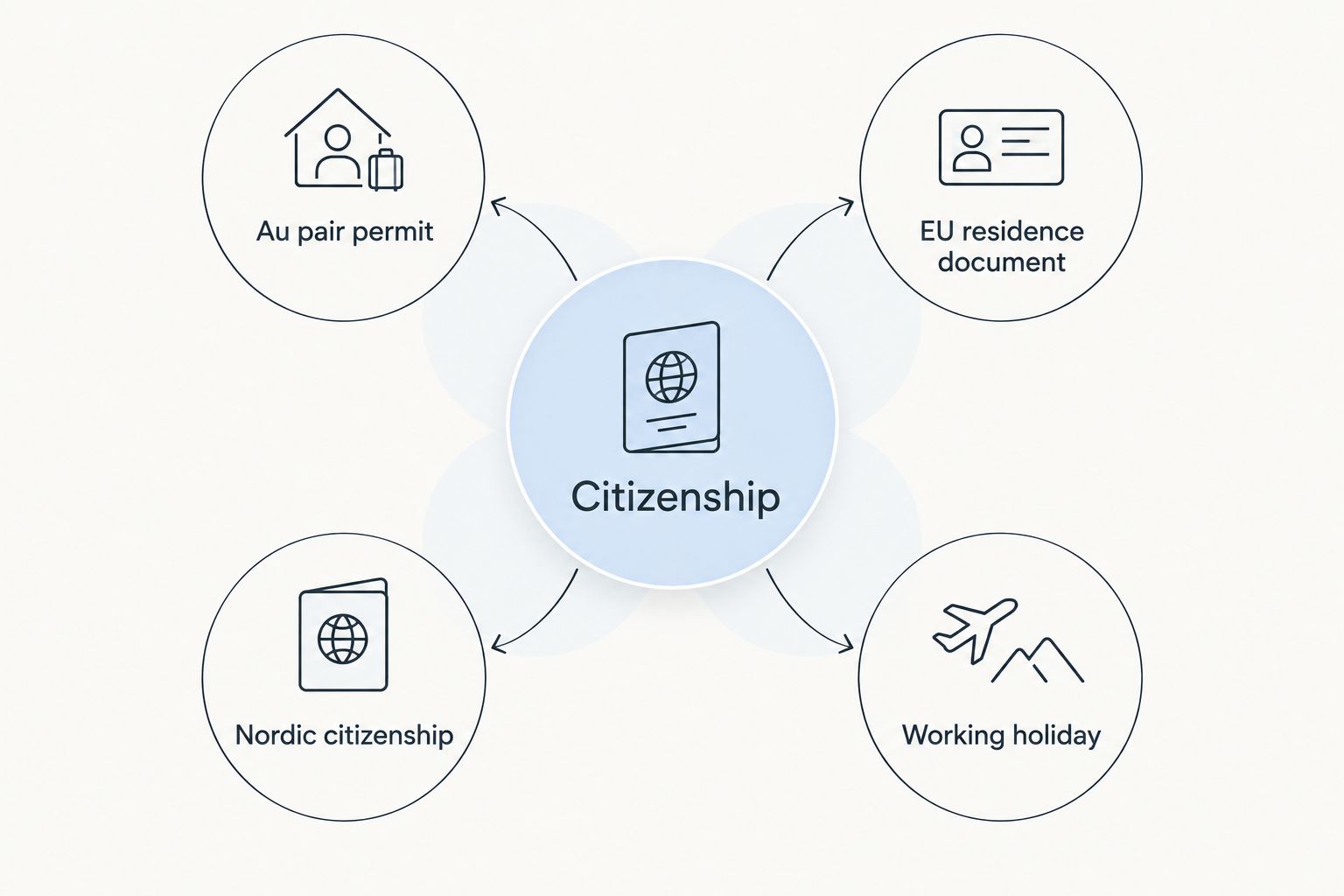
Short answer for 2026: for a non-EU national, the Denmark au pair route is the au pair residence permit processed by SIRI. For EU, EEA and Swiss citizens, the route is the EU residence document. For Nordic citizens, no residence permit is needed. Working holiday is a separate scheme with its own conditions. A short-stay visa is not an au pair route.
Why this matters
The word "visa" causes confusion. In Danish immigration law, a visum - visa - is mainly for short visits. A longer stay with a host family usually needs an opholdstilladelse - residence permit - or, for EU citizens, a document under EU rules.
Choosing the wrong route can lead to an afslag - refusal - or to a stay without the right to do au pair tasks. The route depends mainly on the au pair's citizenship. It does not depend on the host family's wishes.
The au pair scheme is one of several family- and work-related routes into Denmark. If the underlying question is about joining a partner or relative, the overview of family reunification routes ranked by approval difficulty covers that ground.
What decides the right route
These criteria decide which route applies. Read them before the comparison table below.
- Citizenship - Nordic, EU/EEA/Swiss or non-EU. This is the first and main filter.
- Purpose of the stay - au pair stay, paid work, a holiday or a short visit.
- Host family - the au pair permit is built around a specific host family and a contract.
- Right to work - whether the route allows au pair tasks at all.
- Authority - which authority decides the case and which body handles a complaint.
- Documentation - which documents the au pair and the host family provide.
Denmark au pair routes at a glance
| Route | Relevant for | Key feature | Key limitation |
|---|---|---|---|
| Au pair residence permit | Non-EU nationals | Designed for au pair stays with a host family | Conditions apply to the au pair, host family and contract |
| EU residence document | EU, EEA and Swiss citizens | Based on EU rules on free movement | The au pair scheme itself does not apply |
| Nordic citizenship | Citizens of Finland, Iceland, Norway and Sweden | No residence permit needed | Registration in Denmark still applies |
| Working holiday | Nationals of countries with an agreement | Combines a holiday with some work | Not an au pair permit and only for certain countries |
| Short-stay Schengen visa | Visitors | Allows short visits | No right to work as an au pair |
The first question is always citizenship. The route follows from the passport, and the other criteria then decide the details.
1. Au pair residence permit: the route for non-EU nationals
The au pair residence permit is the scheme designed for au pair stays in Denmark. It is processed by Styrelsen for International Rekruttering og Integration, SIRI - the Danish Agency for International Recruitment and Integration. The stay is a cultural exchange, where the au pair lives with a host family and helps with household tasks.
The application involves both the au pair and the værtsfamilie - host family. The host family provides information about the household and the contract. Conditions apply to the au pair, to the host family and to the contract. The current conditions and the current fee are published on nyidanmark.dk.
Au pair residence permit pros:
- It is the route the Danish rules create specifically for au pair stays.
- The conditions are published and the same for all applicants.
- The host family and the au pair apply in one coordinated case.
Au pair residence permit cons:
- Conditions apply to both parties, so a problem on the host family side can affect the case.
- The case is built on a specific host family. A change of host family usually requires a new application.
- An au pair permit is not a general work permit.
Au pair residence permit status: fits non-EU nationals with a Danish host family.
2. EU residence document: the route for EU, EEA and Swiss citizens
Citizens of EU and EEA countries and Switzerland do not use the au pair scheme. Their stay in Denmark is covered by EU rules on free movement. SIRI issues the EU-opholdsdokument - EU residence document.
Which category applies under EU rules depends on the facts of the stay. The authority considers the actual arrangement, not only the label "au pair".
EU residence document pros:
- It rests on free movement rights, not on the au pair scheme.
- The conditions of the au pair scheme do not apply.
- It is issued by SIRI, the same authority that handles many other residence matters.
EU residence document cons:
- The category under EU rules depends on the facts, which can be unclear in a household arrangement.
- Family members from outside the EU follow their own rules.
EU residence document status: fits EU, EEA and Swiss citizens.
3. Nordic citizenship: the route for Nordic nationals
Citizens of Finland, Iceland, Norway and Sweden can live and work in Denmark without a residence permit. This follows from Nordic cooperation.
Nordic citizenship pros:
- No residence permit application.
- No au pair scheme conditions.
- No application to SIRI for the right to stay.
Nordic citizenship cons:
- Registration in the Danish civil registration system - CPR - still applies after moving.
- It covers only Nordic citizens, not their non-Nordic family members.
Nordic citizenship status: fits Nordic citizens only.
4. Working holiday: an alternative for certain nationalities
Denmark has working holiday agreements with a number of countries. A working holiday permit combines a holiday with some work. It is processed by SIRI. It is a separate scheme with its own conditions, and it is not an au pair permit.
Working holiday pros:
- It is not linked to one host family.
- It allows some work during the stay.
Working holiday cons:
- It is only open to nationals of countries with an agreement.
- Whether a specific household arrangement fits the scheme depends on its conditions.
Working holiday status: fits nationals of agreement countries who do not want an au pair stay.
5. Short-stay Schengen visa: not an au pair route
A short-stay Schengen visa allows visits. It does not give a right to work as an au pair. Some readers arrive with this route in mind because of the word "visa" in their search.
Short-stay visa pros:
- It allows short visits, for example to meet a host family.
Short-stay visa cons:
- It does not cover au pair tasks.
- It cannot replace an au pair residence permit.
Short-stay visa status: does not fit an au pair stay.
How the routes are ordered
The order follows the criteria above. Routes designed for an au pair stay come first, and each route has its own citizenship group. Routes that are not built for au pair stays come last. The order does not describe the chance of approval in any case.
Refusals and complaints
If SIRI refuses an au pair application, the decision can be appealed to Udlændingenævnet - the Immigration Appeals Board. Flygtningenævnet handles asylum appeals only and is not involved in au pair cases.
Deadlines apply in this type of case. Contact a lawyer to find out which deadlines apply in your case.
Which route fits?
The route follows from citizenship. For a non-EU national with a Danish host family, the Denmark au pair route in 2026 is the au pair residence permit. For EU, EEA and Swiss citizens it is the EU residence document, and for Nordic citizens no permit is needed.
Globe Advokater works with residence permits and complaints to Udlændingenævnet in Danish and English. For a question about a specific case, book a meeting with Globe Advokater.
FAQ
Is there a Denmark au pair visa?
For a non-EU national, the au pair route is a residence permit, not a visa. The application is processed by SIRI.
Which authority processes au pair applications in Denmark?
SIRI processes au pair residence permit applications. The host family takes part in the application.
Do EU citizens need an au pair residence permit?
No. EU, EEA and Swiss citizens are covered by EU rules on free movement and can obtain an EU residence document from SIRI.
Can a Schengen visa be used for an au pair stay?
No. A short-stay Schengen visa allows visits and does not give a right to work as an au pair.
Where is a refused au pair application appealed?
A refusal from SIRI in an au pair case is appealed to Udlændingenævnet. Flygtningenævnet only handles asylum appeals.
Is working holiday the same as an au pair permit?
No. Working holiday is a separate scheme for nationals of countries with an agreement with Denmark, with its own conditions.
Can an au pair change host family?
The au pair permit is built on a specific host family and contract. A change of host family usually requires a new application.
One last thing
In an au pair case, the host family is part of the application. A refusal can therefore concern the host family's side of the case, not only the au pair. Reading the reasons in the afslag - refusal - with this in mind makes the decision easier to understand in 2026.
Related guides
- Post-study work visas for graduates in Denmark
- Visa options for remote workers in Denmark
- Visas for artists and creatives moving to Denmark
This article is general information about the rules and practice in force. It is not legal advice, it does not assess your specific case, and reading it does not create a client relationship.
Rules, deadlines and the practice of the authorities change. We accept no liability for errors or for changes after the update date. Always check the information with the relevant authority or contact a lawyer before you act.
If you have a specific case, you are welcome to contact Globe Advokater for an assessment.
Last updated 29 September 2026.