
General information about the rules in force. Not legal advice. Last updated 24 September 2026.
Artists and creatives moving to Denmark in 2026 rarely find one dedicated artist visa. This page ranks the main denmark visa artists creatives routes by how they fit creative work, employment form and the way SIRI assesses applications.
- No single artist visa exists in Denmark in 2026 - several work and residence routes apply.
- Special individual qualifications suit established artists with a Danish job offer.
- Positivlisten and Beløbsordningen fit employed creatives when the role and pay match the scheme.
- Self-employment and Start-up Denmark cover independent and founder paths.
- Globe Advokater advises internationals on residence and work permit procedures in Denmark.
Why this matters
Creative careers often mix employment, freelance projects, touring and studio work. Danish residence rules are built around defined grounds such as a job offer, a shortage occupation, a salary band or a viable business. Matching the ground to the work pattern is the core decision in 2026.
Third-country nationals need a residence permit that allows the intended work. EU and EEA citizens move under free movement rules and do not use these schemes. The sections below focus on non-EU routes that creatives actually use.
Globe Advokater works with foreign nationals on immigration and residence matters in Copenhagen. The firm explains procedures in general terms so you can see which route belongs to which situation before a meeting.
Best overall: special individual qualifications for recognised artists with a Danish employment offer. Best for employed creatives on a standard contract: Positivlisten or Beløbsordningen. Best for independent practice: self-employed residence. Best for creative founders: Start-up Denmark.
What makes a strong visa path for artists and creatives
Use these criteria when you compare routes. They mirror how applications are framed toward SIRI and related authorities.
- Ground of residence - the permit must match employment, shortage list, salary scheme, self-employment or start-up rules
- Fit to creative work - touring, project contracts, studio practice and mixed income are not treated the same way
- Employer role - some schemes need a Danish employer or a certified Fast-track company
- Documentation load - portfolio, contracts, business plan and proof of qualifications differ by scheme
- Room for side activity - some permits are narrow on what work is allowed
- Path after entry - extension and later permanent residence depend on the original ground
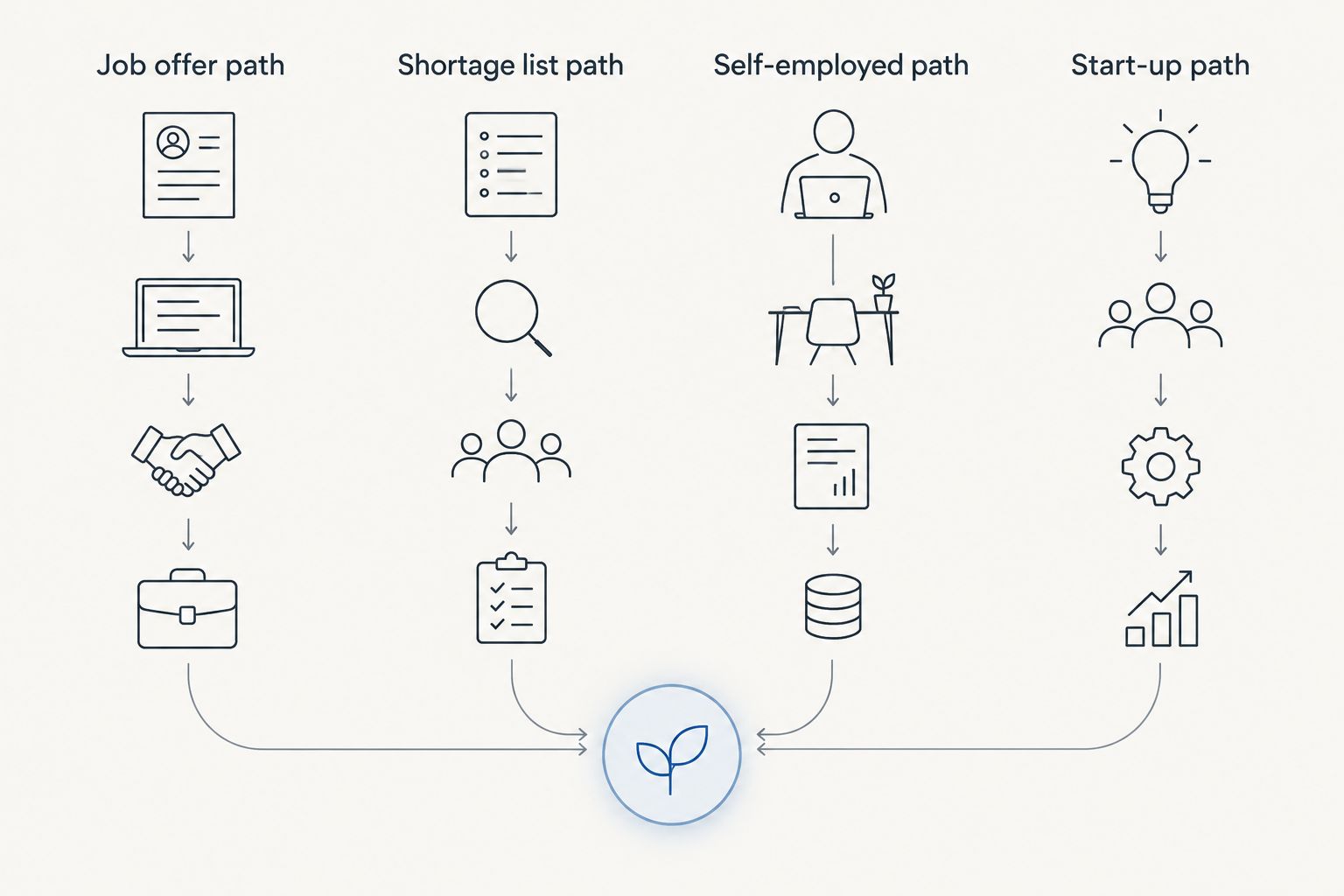
Visa options at a glance
| Route | Best for | Standout feature | Key limitation |
|---|---|---|---|
| Special individual qualifications | Recognised artists with a job offer | Focus on artistic standing and the specific role | Needs a concrete Danish employment offer |
| Positivlisten | Creatives in listed shortage roles | Shortage occupation frame | Role must match the current list |
| Beløbsordningen | Employed creatives with high pay offers | Salary-based gate | Employment and pay must meet the scheme |
| Fast-track | Hires by certified Danish employers | Employer-led process | Only with a certified company |
| Self-employed residence | Freelancers and studio owners | Built for independent practice | Business viability is central |
| Start-up Denmark | Creative founders with scalable ideas | Founder-focused evaluation | Innovation and growth logic, not pure art practice |
1. Special individual qualifications: best for recognised artists with a Danish job offer
This route is aimed at people whose work rests on special individual qualifications - særlige individuelle kvalifikationer. In creative fields it is the closest fit when a Danish employer hires an artist, performer or creative specialist because of standing in the field, not only because of a generic job title.
SIRI assesses the role, the offer and the qualifications together. The permit is a work-related residence permit, not a cultural touring stamp. Short guest performances and pure visit stays sit under other rules and are outside this ranking.
A related pattern appears for people moving on athletic grounds. The structure of proof differs, but the idea of special qualifications is similar - see also visas for foreign athletes moving to Denmark.
Special individual qualifications pros:
- Aligns with artistic reputation and role-specific hiring
- Works when the job title is not a standard shortage label
- Clear employment anchor for the authority
- Familiar frame for international performers and senior creatives
Special individual qualifications cons:
- A real Danish job offer is normally required
- Portfolio and reference evidence must support the claim of special standing
- Mixed freelance income alone does not carry this ground
Best for: established artists and creatives hired into a defined Danish role on the basis of individual standing.
Verdict: Priority path when the offer and the artistic profile are both strong.
2. Positivlisten: best for creatives in shortage occupations
Positivlisten - the Positive List - names occupations with a shortage of qualified workers in Denmark. When a creative role appears on the list in force, an employer can use that frame for a work residence application through SIRI.
List content changes. Design, media, teaching and technical creative roles sometimes appear; many pure art titles do not. The comparison is always against the list text at the time of application, not against a general idea of creative work. For how list professions interact with faster employer routes, see Positivlisten professions for Fast-track work permits.
Positivlisten pros:
- Transparent occupation-based criterion
- Well-known scheme for skilled employment
- Fits permanent creative staff roles in listed fields
- Employer and applicant share a clear checklist
Positivlisten cons:
- Many artistic job titles never appear on the list
- The offer must match the listed occupation closely
- List updates can move a role in or out
Best for: creatives whose exact role is on the Positive List when they apply.
Verdict: Strong path when the title matches; weak path when it does not.
3. Beløbsordningen: best for employed creatives with strong salary offers
Beløbsordningen - the Pay Limit Scheme - is a salary-based work residence route administered in the SIRI scheme family. The authority looks at the employment contract and whether pay meets the scheme threshold in force for the year of application.
Creative directors, senior designers, producers and other employed specialists sometimes use this route when the role is not on Positivlisten but the package meets the pay gate. The scheme does not grade artistic merit. It grades employment and pay.
Threshold figures change and belong on the official SIRI and nyidanmark materials for 2026. This article does not restate them.
Beløbsordningen pros:
- Occupation list is not the main gate
- Fits ordinary employment contracts
- Common route for well-paid specialists
- Clear document set around contract and pay
Beløbsordningen cons:
- Pay must meet the scheme level
- Pure project or low-hour creative work often falls short
- Does not by itself solve freelance-only careers
Best for: creatives with a full employment offer that meets the pay scheme.
Verdict: Priority employment path when salary qualifies; poor fit for low-pay or irregular gigs.
4. Fast-track scheme: best when a certified Danish employer sponsors the hire
The Fast-track scheme is employer-led. Certified Danish companies can bring in foreign employees under a streamlined SIRI process when the hire meets the scheme conditions.
For artists and creatives this matters most inside larger cultural institutions, media groups, game studios and design firms that already hold certification. The individual application still rests on a real job. Certification only changes how the employer files and tracks the case.
Fast-track pros:
- Built for certified employers who hire often
- Can combine with pay or qualification logic used by the company
- Reduces process friction on the employer side
- Useful inside larger creative organisations
Fast-track cons:
- Not available without a certified employer
- Does not create a solo artist route
- Small studios and freelancers gain nothing from the label alone
Best for: creatives hired by a Fast-track certified Danish employer.
Verdict: Strong when the employer is certified; irrelevant when they are not.
5. Self-employed residence: best for freelance and independent creatives
Residence as a self-employed person - selvstændig erhvervsdrivende - is the main frame when creative income comes from your own practice rather than a wage. Studio artists, designers with client rosters, photographers and similar profiles often look here when there is no employer sponsor.
SIRI examines whether the business is real, viable and active in Denmark. Plans, contracts, client evidence and financial setup matter more than reputation alone. The permit is not a soft alternative to a refused work scheme. It is a different ground with its own proof standard.
Self-employed residence pros:
- Matches independent creative practice
- No requirement for a wage employer
- Allows a Denmark-based studio or client model
- Natural fit for portfolio careers with multiple buyers
Self-employed residence cons:
- Business viability is closely tested
- Thin client pipelines and pure hobby practice fail the frame
- Preparation of accounts and plans is heavier than a simple job offer file
Best for: freelancers and independent creatives who will run a genuine Danish practice.
Verdict: Priority path for true self-employment; weak for people who mainly want a job search base.
6. Start-up Denmark: best for creative founders building a scalable business
Start-up Denmark is aimed at founders whose business idea is evaluated for innovation and growth potential. Creative technology, design-led products, games and content platforms sometimes fit. A purely local art practice without a scalable model usually does not.
The scheme is not a general artist visa. It is a founder scheme. Evaluation panels and SIRI process steps follow the start-up rules, not cultural grant logic. Founders who need the wider founder landscape can compare notes with visas for startup founders in Denmark.
Start-up Denmark pros:
- Designed for founders rather than employees
- Fits creative businesses with product or platform logic
- Separate evaluation track from ordinary work permits
- Clear identity as a start-up residence ground
Start-up Denmark cons:
- Artistic merit alone is not the test
- Scalability and innovation expectations exclude many studio practices
- Team and business plan quality dominate the file
Best for: creatives who are founding a scalable company, not only practising art.
Verdict: Situational path - strong for founders, poor for solo practice without a growth model.
How we ranked these routes
Ranking follows the criteria above: ground of residence, fit to creative work patterns, employer dependence, documentation load, activity limits and later extension logic. Schemes that map cleanly onto how artists actually earn sit higher for this audience. Schemes that only work inside narrow employment or founder facts sit lower as general creative tools.
Official scheme pages on nyidanmark.dk and siri.dk define the live conditions. List content and pay gates move over time. Always read the scheme text in force for 2026 rather than older summaries.
Deadlines apply in this type of case. Contact a lawyer to find out which deadlines apply in your case.
Which Denmark visa path should creatives choose?
If a Danish employer hires you because of individual artistic standing, special individual qualifications is the default frame to examine first. If the role is on Positivlisten, use that occupation route. If pay meets Beløbsordningen and the contract is ordinary employment, the pay scheme is often the cleanest file.
If a certified company is the employer, Fast-track becomes relevant as process design. If there is no employer and the plan is a real Danish practice, self-employed residence is the coherent ground. If the project is a scalable company, Start-up Denmark is the founder track.
EU and EEA citizens do not choose among these visas. Free movement rules apply instead. Family-based residence is a separate topic when a partner or child supplies the ground.
Globe Advokater can walk through which ground matches the facts of a case in a meeting. The firm does not rank outcomes in advance and does not treat an article as advice on an individual file.
FAQ
Is there a dedicated artist visa for Denmark in 2026?
No. Denmark has no single artist visa in 2026. Artists and creatives use work and residence schemes such as special individual qualifications, Positivlisten, Beløbsordningen, self-employment or Start-up Denmark.
What is the best denmark visa artists creatives option for freelancers?
Self-employed residence is the usual frame when income comes from independent practice rather than a wage. SIRI looks at whether the business is viable and active in Denmark.
Can I move to Denmark as a creative without a job offer?
Some grounds need no wage employer, including self-employed residence and Start-up Denmark when the business tests are met. Pure job-search without another ground is not what these schemes are for.
Does Positivlisten cover artists?
Only when the exact occupation is on the Positive List in force. Many artistic titles are absent. The live list text decides, not a general creative label.
Is Beløbsordningen open to designers and other creatives?
Yes when the employment offer meets the scheme’s pay and contract conditions. The scheme is salary-based and does not grade artistic portfolio quality.
Who handles work residence applications for these schemes?
SIRI handles the main work and scheme-based residence routes described here, including Positivlisten, Beløbsordningen, Fast-track and related employment grounds.
Do EU citizens need these visas to work as artists in Denmark?
No. EU and EEA citizens use free movement rules. The ranked schemes are for third-country nationals.
How does Start-up Denmark differ from self-employed residence for creatives?
Start-up Denmark tests innovation and growth potential for founders. Self-employed residence tests a viable independent business. A local studio practice and a scalable creative company are different grounds.
One last thing
Creative careers often look hybrid on paper - part employment, part freelance, part touring. Danish residence grounds are not hybrid by default. The application usually has to pick one coherent ground and prove that ground. Files that try to be every type of creative at once are harder for SIRI to place. Clarity on the main economic activity in 2026 is often worth more than a longer portfolio.
Related guides
- Best visa options for remote workers in Denmark
- Denmark work permits ranked by processing time
- Best post-study work visas for graduates in Denmark
This article is general information about the rules and practice in force. It is not legal advice, it does not assess your specific case, and reading it does not create a client relationship.
Rules, deadlines and the practice of the authorities change. We accept no liability for errors or for changes after the update date. Always check the information with the relevant authority or contact a lawyer before you act.
If you have a specific case, you are welcome to contact Globe Advokater for an assessment.
Last updated 24 September 2026.