
General information about the rules in force. Not legal advice. Last updated 29 September 2026.
For EU and EEA citizens, seasonal and farm work in Denmark does not require a work permit - an EU residence document from SIRI covers it. For non-EU citizens, the realistic routes are Positivlisten for faglært arbejde, Beløbsordningen, the supplementary pay limit scheme and, for some nationalities, a working holiday permit. This guide explains how each route works in general terms, as of September 2026.
- EU, EEA and Swiss citizens need an EU residence document from SIRI, not a work permit, for farm work.
- Non-EU seasonal agricultural workers need a Danish work permit tied to one employer and one job.
- Positivlisten for faglært arbejde covers skilled roles only when the job title is on the current list.
- Beløbsordningen depends on a salary threshold that SIRI sets each year.
- Refusals of work permits are appealed to Udlændingenævnet, not Flygtningenævnet.
Why this matters
If you are looking for a Denmark work permit for seasonal agricultural workers, you will find that Denmark has no single seasonal permit that fits every farm job. The correct route depends on your citizenship, your qualifications and the salary in the job offer.
Choosing the wrong scheme is a common reason for a refusal. The scheme also decides whether family members can come with you and what happens if you change employer. Globe Advokater works with internationals and Danish employers on these questions. For skilled roles outside farming, see our guide to work permits for skilled trades workers.
The general rules on work and residence permits for employment are in udlændingelovens § 9 a - section 9 a of the Danish Aliens Act. The detailed conditions for each scheme are published on nyidanmark.dk and siri.dk.
What decides which route fits seasonal and farm work
The authorities look at the same core questions in every case. Before reading about each scheme, check your situation against these points:
- Citizenship - EU, EEA and Swiss citizens follow EU rules. Everyone else follows Danish work permit rules.
- Qualifications - some schemes require a recognised vocational education or a specific job title.
- Salary - some schemes require pay above a fixed annual threshold.
- Danish pay and working conditions - for non-EU schemes, the salary and conditions must match what is normal in Denmark for that type of work, according to nyidanmark.dk.
- A concrete job offer - every non-EU work scheme described here requires a signed contract or job offer from a Danish employer.
- Nationality agreements - the working holiday route exists only for citizens of countries that have an agreement with Denmark.
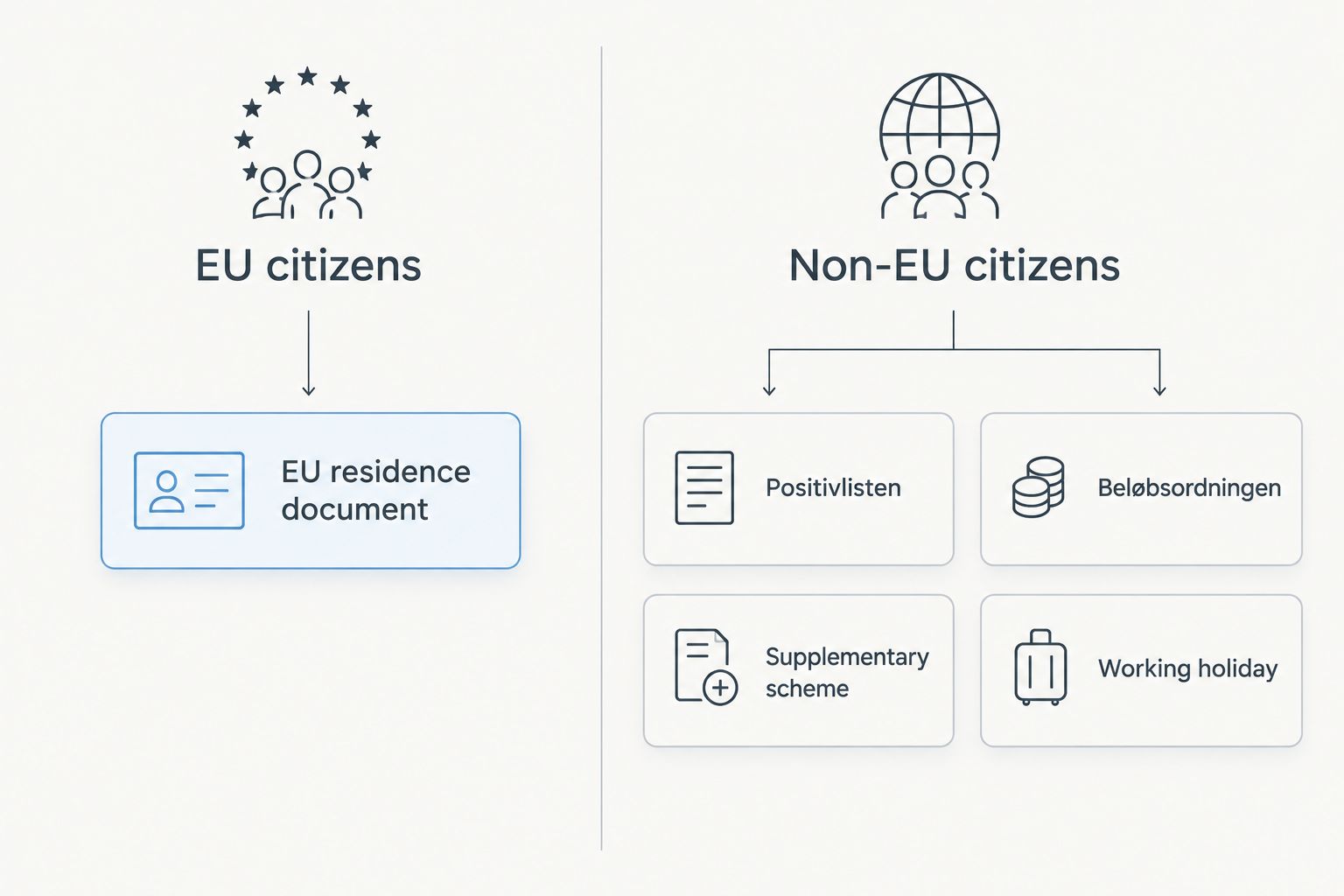
Seasonal and farm work routes at a glance
| Route | Relevant for | Key feature | Key limitation |
|---|---|---|---|
| EU residence document | EU, EEA and Swiss citizens | No work permit needed | Only for citizens covered by EU free movement rules |
| Positivlisten for faglært arbejde | Non-EU workers with a vocational education | No fixed salary threshold | The job title must be on the current list |
| Beløbsordningen | Non-EU workers with a well-paid job offer | No education requirement | Salary must reach the annual threshold |
| Supplementary pay limit scheme | Non-EU workers below the Beløbsordningen threshold | Lower salary threshold | Extra conditions on the job and its advertisement |
| Working holiday | Young people from agreement countries | Temporary work while travelling | Only certain nationalities and age groups |
1. EU residence document: the route for EU and EEA citizens
Citizens of the EU, the EEA and Switzerland can work in Denmark under the EU rules on free movement. They do not need a Danish work permit. Instead, they apply to SIRI for an EU residence document - EU-opholdsdokument - under the rules in EU-opholdsbekendtgørelsen, the Danish executive order on EU residence.
EU residence document pros:
- No work permit application and no employer-specific permit.
- Free choice of employer, including several seasonal employers in a row.
- Family members may also have rights under the EU rules.
EU residence document cons:
- Not available to non-EU citizens, even if they hold a residence permit in another EU country.
- The conditions for keeping the right of residence depend on your status as a worker.
Relevant for: EU, EEA and Swiss citizens taking harvest, dairy, greenhouse or other farm jobs in Denmark.
2. Positivlisten for faglært arbejde: the route for skilled farm workers
Positivlisten for faglært arbejde - the positive list for skilled work - is a list of job titles where Denmark has a shortage of qualified labour. If a job title is on the list and you have the relevant vocational education, you can apply for a work permit through SIRI. The list is updated regularly, so an agricultural job title may appear on one version of the list and not on the next.
The salary and employment conditions must match normal Danish standards for the job. Our guide to Positivlisten professions explains in more detail how the list works.
Positivlisten pros:
- No fixed annual salary threshold.
- Suits workers with a formal vocational education in farming or related trades.
- Accompanying family members can usually apply for residence at the same time.
Positivlisten cons:
- The exact job title in the contract must match a title on the current list.
- Informal experience without a recognised education is usually not enough.
- The permit is tied to the specific employer and job.
Relevant for: non-EU workers with a recognised vocational education whose farm job title appears on the current list.
3. Beløbsordningen: the route for well-paid farm jobs
Beløbsordningen - the pay limit scheme - is based on salary alone. If the job pays at least the threshold set for the year, there is no requirement for a specific education or job title. SIRI publishes the threshold for 2026 on siri.dk and nyidanmark.dk, and the figure changes every year.
For many seasonal and harvest jobs, the salary may not reach the threshold. Management, specialist or technical roles on larger farms are more likely to meet it. The same scheme is often used in other sectors - see our guide to the pay limit scheme for IT professionals.
Beløbsordningen pros:
- No education or job title requirement.
- A clear, published salary condition.
- Accompanying family members can usually apply for residence.
Beløbsordningen cons:
- The salary threshold is high compared with typical seasonal pay.
- The salary must be paid into a Danish bank account, according to nyidanmark.dk.
- The permit is tied to the specific employer and job.
Relevant for: non-EU workers with a farm management, technical or specialist role that pays above the annual threshold.
4. The supplementary pay limit scheme: the route below the main threshold
Den supplerende beløbsordning - the supplementary pay limit scheme - has a lower salary threshold than Beløbsordningen. In exchange, it has extra conditions, including requirements about how the employer has advertised the job. The full list of conditions is on nyidanmark.dk and siri.dk, and the threshold for 2026 is published there.
Supplementary scheme pros:
- A lower salary threshold than the main pay limit scheme.
- No requirement that the job title is on a shortage list.
Supplementary scheme cons:
- More conditions than the main scheme, on both the job and the employer.
- The scheme can be suspended depending on labour market conditions, according to nyidanmark.dk.
Relevant for: non-EU workers with a full-time farm job offer that pays below the Beløbsordningen threshold but meets the supplementary conditions.
5. Working holiday: the route for young travellers
Arbejdsferieophold - a working holiday residence permit - lets young people from a limited number of countries stay in Denmark and take temporary jobs, including farm and seasonal work. Only citizens of countries with a working holiday agreement with Denmark can apply, and age limits apply. The current list of countries and conditions is on nyidanmark.dk.
Working holiday pros:
- Not tied to one employer.
- Suits short seasonal jobs such as harvest work.
Working holiday cons:
- Only for certain nationalities and age groups.
- The main purpose must be the holiday, not the work.
Relevant for: young people from agreement countries who want seasonal farm work as part of a stay in Denmark.
How the routes are ordered
The order follows the criteria above. The EU route comes first because it applies to the largest group of seasonal farm workers in Denmark and involves no work permit. The non-EU routes follow in order of how closely they match skilled, well-paid and then lower-paid farm jobs. Working holiday comes last because it is limited to specific nationalities. The order is not a ranking of quality or of chances of approval - the authorities decide each case on its own facts.
Which route fits which situation?
In general terms, the rules mean:
- EU, EEA or Swiss citizen - the EU residence document route applies, not a work permit.
- Non-EU citizen with a vocational education and a listed job title - Positivlisten for faglært arbejde is the scheme the authority considers.
- Non-EU citizen with a high salary - Beløbsordningen is the scheme the authority considers.
- Non-EU citizen with a lower salary and a full-time job - the supplementary pay limit scheme may be relevant.
- Young citizen of an agreement country - a working holiday permit may be relevant.
If an application is refused, work permit decisions from SIRI can be appealed to Udlændingenævnet - the Immigration Appeals Board. Deadlines apply in this type of case. Contact a lawyer to find out which deadlines apply in your case.
Globe Advokater can review which scheme matches a specific job offer. Book a meeting through the contact page on our website.
FAQ
Do EU citizens need a work permit for seasonal farm work in Denmark?
No. EU, EEA and Swiss citizens can work in Denmark under the EU free movement rules and apply to SIRI for an EU residence document instead of a work permit.
Is there a special seasonal work permit for agricultural workers in Denmark?
Non-EU seasonal agricultural workers apply under the general Danish work schemes, such as Positivlisten for faglært arbejde or Beløbsordningen. The scheme depends on qualifications, job title and salary.
Can a farm job qualify under Positivlisten?
Yes, if the exact job title is on the current Positivlisten for faglært arbejde and the worker has the relevant vocational education. The list is updated regularly, so the current version on nyidanmark.dk decides.
What is the salary threshold for Beløbsordningen?
SIRI sets a new threshold every year. The current figure is published on siri.dk and nyidanmark.dk.
Can I change farm employer with a Danish work permit?
Not on the same permit. Work permits under these schemes are tied to a specific employer and job, so a new job usually requires a new permit.
Where do I appeal a refused work permit?
Refusals of work permits are appealed to Udlændingenævnet, the Immigration Appeals Board. Asylum cases are different and go to Flygtningenævnet.
Can my family join me if I work on a Danish farm?
Under Positivlisten and Beløbsordningen, accompanying family members can usually apply for residence. EU citizens follow the EU rules on family members instead.
One last thing
A Danish work permit is tied to one employer and one job. If a seasonal job ends and you find work on another farm, the permit does not move with you - a new application is usually needed before starting the new job. The working holiday route and the EU route are the two exceptions described in this guide. Globe Advokater advises both workers and employers on this point.
Related guides
- Denmark work permits ranked by processing time
- Family reunification visas ranked by approval difficulty
This article is general information about the rules and practice in force. It is not legal advice, it does not assess your specific case, and reading it does not create a client relationship.
Rules, deadlines and the practice of the authorities change. We accept no liability for errors or for changes after the update date. Always check the information with the relevant authority or contact a lawyer before you act.
If you have a specific case, you are welcome to contact Globe Advokater for an assessment.
Last updated 29 September 2026.