
General information about the rules in force. Not legal advice. Last updated 29 September 2026.
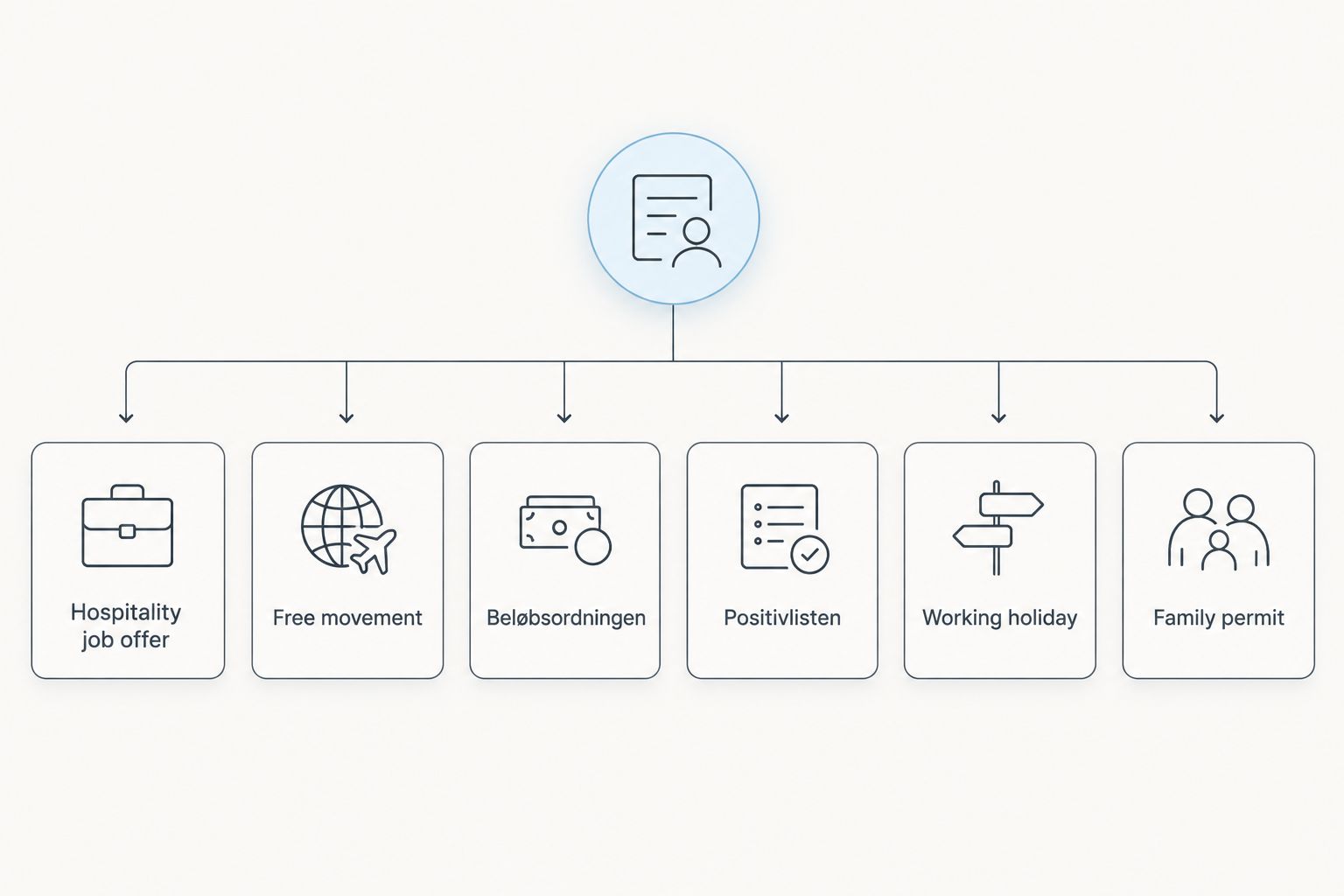
Hospitality work in Denmark - restaurants, hotels, cafés and catering - does not have its own work permit, so the question is which general route fits the job and the person. This guide explains how the main routes compare in 2026 and when to ask a lawyer.
- There is no dedicated work permit for hospitality workers in Denmark in 2026.
- EU, EEA, Swiss and Nordic citizens use free movement rules, not a work permit.
- Non-EU hospitality staff usually look at Beløbsordningen, Positivlisten or the supplementary pay limit scheme.
- Working holiday permits cover temporary work for young people from agreement countries.
- Globe Advokater assists with work permit applications and appeals to Udlændingenævnet.
Why this matters
Many people are offered a job in a Danish kitchen or hotel before they know which permit applies. The job offer alone does not decide the route. Nationality, salary, job title and education all matter.
The work permit for hospitality workers in Denmark is therefore not one document but a choice between schemes. Each scheme has its own conditions, and SIRI - Styrelsen for International Rekruttering og Integration, the Danish Agency for International Recruitment and Integration - decides most applications. Appeals in work permit cases go to Udlændingenævnet - the Immigration Appeals Board.
The schemes also differ in how long a decision usually takes. For a comparison, see Danish work permits compared by processing time.
This article goes one level deeper than the firm's general page on arbejdstilladelse - work permits - and looks only at hospitality roles.
The short answer
For EU, EEA, Swiss and Nordic citizens, the relevant route is free movement, not a work permit. For other nationals, the route most often discussed for hospitality jobs is Beløbsordningen when the salary is high enough, and Positivlisten for skilled work when the job title appears on the current list. Working holiday covers young people from countries with an agreement with Denmark.
Globe Advokater is a Copenhagen law firm that helps foreign nationals with work permits, including hospitality roles such as chefs, cooks and hotel staff.
What makes a work permit route fit a hospitality job
The routes below are compared on the same criteria:
- Who can use it - nationality and age conditions.
- Job and salary conditions - whether the scheme depends on pay level, job title or education.
- Employer involvement - whether the employer carries part of the application.
- Flexibility - whether the permit is tied to one employer or one job.
- Family - whether a partner and children can come along.
- Source clarity - whether the scheme is described on nyidanmark.dk or siri.dk.
Hospitality work routes in Denmark at a glance
| Route | Typically relevant for | Standout feature | Key limitation |
|---|---|---|---|
| Free movement for EU, EEA, Swiss and Nordic citizens | Hospitality staff with EU, EEA, Swiss or Nordic citizenship | No work permit needed | Not available to other nationals |
| Beløbsordningen - Pay Limit Scheme | Senior roles such as head chefs or hotel managers | No list of approved job titles | Requires a salary above the annual threshold |
| Supplerende beløbsordning - Supplementary Pay Limit Scheme | Roles with pay below the main threshold | Lower salary threshold | Extra conditions apply to the job and recruitment |
| Positivlisten for faglærte - Positive List for Skilled Work | Trained cooks or chefs with a recognised qualification | Based on the job title and training | Only works if the title is on the current list |
| Working holiday | Young people from agreement countries | Allows temporary work in many sectors | Limited to certain nationalities and ages |
| Permit as an accompanying family member | Partners of people already holding a Danish permit | Work access follows the family permit | Depends on the main person's permit |
1. Free movement: the route for EU, EEA, Swiss and Nordic hospitality workers
Citizens of EU and EEA countries and Switzerland do not need a work permit to work in Denmark. Instead, they apply to SIRI for an EU residence document - registreringsbevis, a registration certificate - based on their work. Nordic citizens do not need a registration certificate from SIRI at all.
Free movement - pros:
- No work permit and no salary threshold.
- The right to work is not tied to one employer.
- Changing restaurant or hotel does not require a new permit.
Free movement - cons:
- Only open to EU, EEA, Swiss and Nordic citizens.
- Family members from outside the EU follow their own EU rules and documentation.
Typically relevant for: hospitality workers who hold EU, EEA, Swiss or Nordic citizenship.
2. Beløbsordningen: the route for senior hospitality roles
Beløbsordningen - the Pay Limit Scheme - gives a residence and work permit when the job pays above a fixed annual salary threshold, jf. udlændingelovens § 9 a. The scheme does not depend on the job title, so it can cover any hospitality role that meets the salary condition.
The threshold changes every year. The current figure for 2026 is published on nyidanmark.dk and siri.dk.
Beløbsordningen - pros:
- No list of approved professions.
- No requirement of a specific education.
- Family members can apply for an accompanying permit.
Beløbsordningen - cons:
- Many hospitality salaries are below the threshold.
- The permit is tied to the specific job and employer.
- The salary must be paid into a Danish bank account.
Typically relevant for: head chefs, restaurant managers, hotel managers and other senior roles with a high salary.
3. Supplerende beløbsordning: the route for lower-paid positions
The supplerende beløbsordning - the Supplementary Pay Limit Scheme - uses a lower salary threshold than Beløbsordningen, jf. udlændingelovens § 9 a. It comes with extra conditions about the job and how the position was advertised. The exact conditions and the current threshold are listed on siri.dk.
Supplerende beløbsordning - pros:
- Opens the door for roles that do not meet the main threshold.
- No list of approved professions.
Supplerende beløbsordning - cons:
- Additional conditions make the application more complex.
- The permit is tied to the specific job and employer.
Typically relevant for: hospitality positions where the salary is below the Beløbsordningen threshold but above the supplementary one.
4. Positivlisten for faglærte: the route for trained cooks and chefs
Positivlisten for faglærte - the Positive List for Skilled Work - covers professions where Denmark lacks skilled labour, jf. udlændingelovens § 9 a. The applicant needs a job on the list and a relevant vocational qualification. Whether a hospitality title such as cook or chef appears on the list depends on the current version, which is updated regularly and published on nyidanmark.dk.
For a closer look at how the list works, see Positivlisten professions and the Fast-track scheme.
Positivlisten - pros:
- Based on the job title and training, not a high salary.
- Family members can apply for an accompanying permit.
Positivlisten - cons:
- Only works if the exact job title is on the current list.
- The applicant's qualification must match the job.
- Salary and terms must meet Danish standards.
Typically relevant for: cooks and chefs with a recognised vocational qualification, when the job title is on the list at the time of application.
5. Working holiday: the route for young seasonal workers
A working holiday permit gives young people from countries with a working holiday agreement with Denmark a permit to stay and work for a limited period. SIRI decides these applications. Nationality and age conditions differ between agreements, and the list of countries is published on nyidanmark.dk.
Working holiday - pros:
- Not tied to one employer.
- No salary threshold or approved list of jobs.
Working holiday - cons:
- Only for certain nationalities and age groups.
- The permit is temporary and does not lead to a longer stay on its own.
Typically relevant for: young people who want seasonal or short-term work in restaurants, hotels or tourism.
6. Accompanying family permit: the route for partners already in Denmark
When a partner holds a Danish work permit under a scheme such as Beløbsordningen or Positivlisten, the family can apply for a permit as accompanying family members. That permit usually gives access to the Danish labour market, including hospitality jobs.
Accompanying family permit - pros:
- No separate job-based application for the partner.
- Work is not tied to one employer.
Accompanying family permit - cons:
- Depends on the main person's permit continuing.
- A change in the main person's job can affect the family permit.
Typically relevant for: partners of people who already work in Denmark.
How the routes were compared
Each route was compared on the six criteria above: who can use it, job and salary conditions, employer involvement, flexibility, family access and source clarity. Every scheme described here appears on nyidanmark.dk or siri.dk in 2026. The order reflects how often each route is relevant to hospitality jobs, not how easy it is to obtain.
Conditions change. Salary thresholds are updated each year, and Positivlisten is revised regularly, so the current versions on the official sites are the reference point.
Which route applies to a hospitality job?
The starting point is nationality. EU, EEA, Swiss and Nordic citizens use free movement. For everyone else, the salary decides whether Beløbsordningen or the supplementary scheme is relevant, and the job title and training decide whether Positivlisten is relevant. Working holiday and family permits depend on the person's own situation.
If SIRI refuses an application, the decision can be appealed to Udlændingenævnet. Deadlines apply in this type of case. Contact a lawyer to find out which deadlines apply in your case.
Globe Advokater works in Danish and English and assists with applications and appeals in work permit cases. Individual questions about which scheme fits a specific job are answered in a meeting.
FAQ
Is there a special work permit for hospitality workers in Denmark?
No. Hospitality workers use the general schemes, such as Beløbsordningen, Positivlisten or working holiday. The right scheme depends on nationality, salary and job title.
What is the most common work permit for a chef in Denmark?
For chefs from outside the EU, Beløbsordningen and Positivlisten for skilled work are the schemes most often discussed. Positivlisten only applies if the job title is on the current list.
Do EU citizens need a work permit to work in a Danish restaurant?
No. EU, EEA and Swiss citizens apply to SIRI for a registration certificate instead. Nordic citizens do not need a registration certificate from SIRI.
Can I work in a Danish hotel on a working holiday permit?
A working holiday permit allows temporary work in many sectors, including hotels. It is only available to young people from countries with a working holiday agreement with Denmark.
Is Beløbsordningen or Positivlisten better for hospitality work?
Neither is better in general. Beløbsordningen depends on the salary level, while Positivlisten depends on the job title and the applicant's training.
Who decides work permit applications for hospitality jobs?
SIRI decides applications under the work schemes. Appeals against SIRI's decisions in work permit cases go to Udlændingenævnet.
Can my partner come with me if I get a hospitality work permit?
Under schemes such as Beløbsordningen and Positivlisten, family members can apply for an accompanying permit. The conditions are described on nyidanmark.dk.
One last thing
A job title in a contract carries weight. Under Positivlisten, the authority looks at whether the actual job matches a title on the list and the applicant's training. A contract that says "kitchen assistant" is assessed differently from one that says "chef", even for similar daily tasks. The title and the job description in the contract are therefore part of the application, not a formality.
Related guides
- Work permits for skilled trades workers in Denmark
- Work permits for healthcare workers in Denmark
- Post-study work options for graduates in Denmark
This article is general information about the rules and practice in force. It is not legal advice, it does not assess your specific case, and reading it does not create a client relationship.
Rules, deadlines and the practice of the authorities change. We accept no liability for errors or for changes after the update date. Always check the information with the relevant authority or contact a lawyer before you act.
If you have a specific case, you are welcome to contact Globe Advokater for an assessment.
Last updated 29 September 2026.