
General information about the rules in force. Not legal advice. Last updated 24 September 2026.
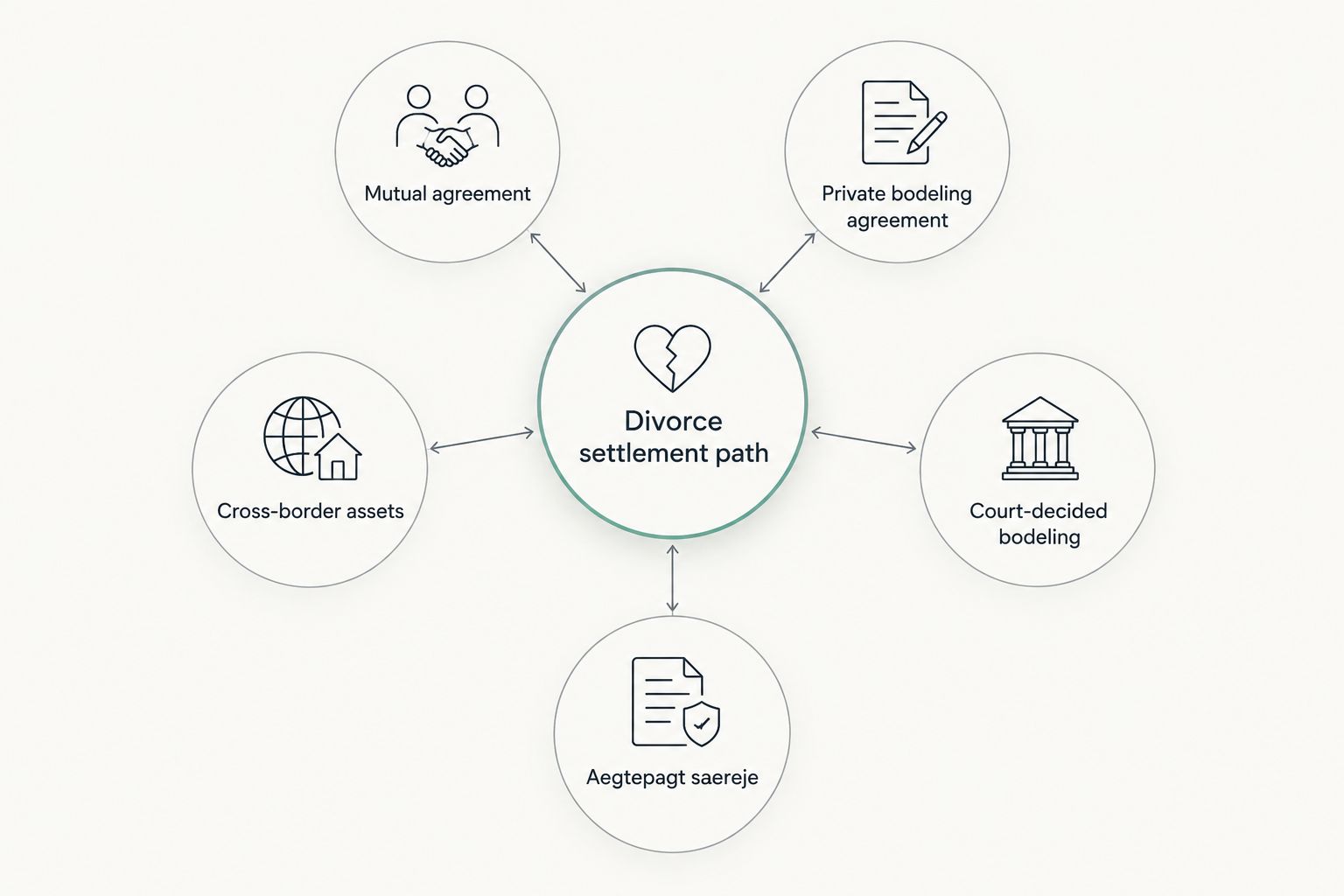
A foreign spouse going through a divorce in Denmark in 2026 has more than one path for settling how the joint estate is divided, and which path applies depends mostly on whether both spouses agree. This guide sets out the main divorce settlement options for a foreign spouse in Denmark, what each one covers, and what each one leaves out.
- Mutual agreement settlement through Familieretshuset works only when both spouses agree on the joint estate.
- A privately negotiated bodeling agreement gives spouses more control without a court date.
- Court-decided bodeling through Familieretten applies once spouses cannot agree on the division.
- A registered aegtepagt keeps saereje property outside bodeling regardless of either spouse's nationality.
- Foreign-held property, accounts or pensions usually need a separate cross-border step alongside the Danish settlement.
Why this matters for a foreign spouse
A Danish divorce follows the same family law framework for a foreign spouse as for a Danish national, once Danish jurisdiction applies to the marriage. The added layer for a foreign spouse usually sits outside the divorce itself - in whether a foreign marriage contract is recognised, whether assets held abroad fall inside the settlement, and whether a residence permit was tied to the marriage in the first place. Globe Advokater works with clients on both sides of these questions in Copenhagen.
The bodeling - division of the joint estate - is a separate step from the skilsmisse - divorce - itself. A couple can be legally divorced while the bodeling is still unresolved, sometimes for a long stretch afterward. That separation between the two steps is the reason several settlement paths exist side by side rather than one single process.
What decides which divorce settlement path applies
- Whether both spouses agree on how to divide the joint estate
- Whether a valid aegtepagt already sets certain assets aside as saereje
- Whether either spouse holds property, accounts or pensions outside Denmark
- Whether custody, bopael or samvaer arrangements for children are also part of the case
- Whether Danish jurisdiction applies to the marriage at all
At a glance: divorce settlement paths for foreign spouses
| Settlement path | Best for | Standout feature | Key limitation |
|---|---|---|---|
| Mutual agreement settlement | Spouses who agree on the estate | One joint application to Familieretshuset | Breaks down if one point is disputed |
| Private bodeling agreement | Spouses who want a written deal outside court | Terms set by the spouses, not a standard form | Needs legal drafting to hold up later |
| Court-decided bodeling | Spouses who cannot agree | A binding ruling from Familieretten | Slower and outside the spouses' control |
| Aegtepagt saereje protection | Spouses with an existing marital agreement | Excludes listed assets from bodeling entirely | Only covers what the aegtepagt names |
| Cross-border asset settlement | Spouses with property outside Denmark | Runs alongside the Danish process | Needs coordination with another country |
1. Mutual agreement settlement through Familieretshuset: best for spouses who already agree
This path runs through Familieretshuset - the Family Law House - the authority that handles separation, skilsmisse, forataeldremyndighed, bopael, samvaer and bidrag as a first instance. Both spouses submit one joint application, and the bodeling can often be settled as part of the same process. It works when the disagreement between spouses is minimal or nonexistent.
Mutual agreement settlement pros:
- Handled entirely by Familieretshuset without a courtroom
- One joint application covers the skilsmisse itself
- The bodeling can be agreed and recorded at the same time
- Applies regardless of either spouse's nationality once Danish jurisdiction applies
Mutual agreement settlement cons:
- Requires real agreement on every asset and debt in the estate
- Not available once one spouse disputes forataeldremyndighed or the terms of division
- A spouse with limited Danish may need documents explained or translated
Best for: spouses who already agree on how to divide what they own.
2. Privately negotiated bodeling agreement: best for a written deal without a court date
A privately negotiated bodeling agreement lets spouses set their own terms with legal assistance, rather than following the standard joint application. A lawyer drafts the agreement so it is clear and enforceable later. This path suits spouses who agree in substance but want the detail worked out in writing before anything is signed.
Private bodeling agreement pros:
- Lets spouses set terms outside the standard Familieretshuset form
- A lawyer can draft the agreement so it holds up if questioned later
- Faster than a court date once both sides agree on substance
- Works well when assets sit in more than one country
Private bodeling agreement cons:
- Needs both spouses to negotiate with legal assistance, which takes more coordination than a joint form
- An agreement drafted without legal review can be challenged afterward
- Does not resolve disputes over forataeldremyndighed or samvaer
Best for: spouses who want a formal, written division without going to court.
3. Court-decided bodeling through Familieretten: best for spouses who cannot agree
When spouses cannot agree on how to divide the joint estate, the case moves from Familieretshuset to Familieretten - the Family Court - which issues a binding decision. Both spouses are heard before the court rules. This path exists specifically for the cases the first two paths cannot resolve.
Court-decided bodeling pros:
- Applies when spouses genuinely cannot agree on the division
- Gives a structured process to move a stalled case forward
- Both spouses are heard before a ruling is issued
Court-decided bodeling cons:
- Takes considerably longer than an agreed settlement
- Removes the spouses' control over the final outcome
- Can add legal costs on both sides
Best for: spouses whose disagreement over assets has not moved despite negotiation.
4. Saereje protection under an existing aegtepagt: best for spouses with a marital agreement in place
An aegtepagt - a marital property agreement - can set certain assets aside as saereje - separate property that stays outside the division - before or during the marriage. When registered correctly, saereje property is not part of the bodeling calculation at all. This affects the size and shape of every other settlement path on this list.
“Property listed as saereje in a registered aegtepagt stays outside bodeling regardless of which settlement path the rest of the estate follows.”
Saereje protection pros:
- Property listed as saereje stays outside bodeling entirely
- Reduces the number of assets that need negotiating
- Recognised under Danish family law once properly registered
Saereje protection cons:
- Only covers what the aegtepagt specifically names
- An aegtepagt drawn up abroad may need review to confirm it is valid in Denmark
- Does not remove the need to divide anything left out of the document
Best for: spouses who already hold a valid aegtepagt naming specific saereje assets.
5. Cross-border asset settlement for foreign-held property: best for spouses with assets outside Denmark
Many foreign spouses keep property, bank accounts or pension arrangements in their home country. A Danish bodeling agreement or Familieretten ruling covers the estate as understood under Danish law, but foreign-held assets often need a parallel step involving a lawyer or authority in the other country.
Cross-border settlement pros:
- Addresses property, accounts or pensions held outside Denmark
- Can run alongside a Danish bodeling agreement or court decision
- Relevant for the many foreign spouses who kept assets in their home country
Cross-border settlement cons:
- May require coordination with a lawyer or authority abroad
- Danish bodeling rules do not automatically override foreign property law
- Adds time to a settlement that would otherwise be straightforward domestically
Best for: spouses whose estate includes property or accounts outside Denmark.
How these settlement paths differ
The five paths are not competing options for the same situation - each answers a different starting condition. Agreement or disagreement between the spouses decides between paths one, two and three. An existing aegtepagt decides how much of the estate path four removes from the equation before anything else happens. Assets held outside Denmark add path five on top of whichever domestic path applies.
A single divorce in 2026 can combine more than one of these paths - for example, a saereje-protected property alongside a privately negotiated bodeling agreement for everything else.
Which path applies to your case
The path that fits a given divorce depends on the specific estate, any existing aegtepagt, and whether the spouses agree. None of the descriptions above substitute for a review of the actual documents and assets involved.
Discuss your settlement options
Talk through the estate, any aegtepagt and cross-border assets with a lawyer.
FAQ
What happens to shared assets when a foreign spouse divorces in Denmark?
The joint estate goes through bodeling, the division process, unless specific assets are protected as saereje under a registered aegtepagt. The division can be agreed by the spouses or decided by Familieretten if they cannot agree.
Is a foreign marriage recognised in a Danish divorce?
Denmark generally recognises a marriage validly entered into abroad for the purpose of a Danish divorce, once the case falls under Danish jurisdiction. The divorce process itself then follows the same Danish family law framework as for a Danish couple.
Can foreign spouses divide assets located outside Denmark in a Danish divorce?
A Danish bodeling agreement or court decision covers the estate as understood under Danish law, but property or accounts abroad often need a separate step in the other country. Coordination between the Danish settlement and the foreign asset is usually needed rather than assumed.
Does divorce affect a foreign spouse's residence permit in Denmark?
If a residence permit is based on family reunification tied to the marriage, a divorce can affect the basis for that permit. That question is handled separately by Udlaendingestyrelsen, the Danish Immigration Service, and not as part of the divorce settlement itself.
What is the difference between separation and divorce for property division?
Separation and skilsmisse, divorce, are both handled by Familieretshuset, but the bodeling, division of the joint estate, is a separate step that can happen before, during or after either one is finalised. A couple can be formally divorced while the estate is still unresolved.
Who decides on bodeling if spouses cannot agree?
Familieretshuset handles the case first, and if the spouses cannot reach agreement, it proceeds to Familieretten, the Family Court, for a binding decision. Both spouses are heard before a ruling is issued.
Does an aegtepagt protect assets in a Danish divorce?
Property listed as saereje in a validly registered aegtepagt stays outside the bodeling calculation. An aegtepagt drawn up outside Denmark may need review to confirm it holds up under Danish family law.
One last thing
An aegtepagt drawn up in another country before the marriage is often the single detail that changes which settlement path applies, and it is also the detail most often overlooked until the bodeling conversation has already started. Checking it early, rather than during the negotiation itself, avoids reworking an agreement that assumed the wrong starting point.
Related guides
- Best residence permits for parents of Danish children
- Family reunification visas ranked by approval difficulty
- Best inheritance planning options for foreigners in Denmark
- Best dual citizenship options for non-EU nationals
This article is general information about the rules and practice in force. It is not legal advice, it does not assess your specific case, and reading it does not create a client relationship.
Rules, deadlines and the practice of the authorities change. We accept no liability for errors or for changes after the update date. Always check the information with the relevant authority or contact a lawyer before you act.
If you have a specific case, you are welcome to contact Globe Advokater for an assessment.
Last updated 24 September 2026.